

Targeted heating solutions keep high-bay warehouses warm and safe
By Jamie Tuinstra
High-bay warehouses are designed for efficient storage, manufacturing and logistics. They’re not necessarily designed to ensure consistent comfort; in fact, they can be particularly difficult to keep warm once chilly weather sets in. Yet effective heating is critical, not only for protecting inventory and equipment, but also for ensuring worker safety, morale and productivity.
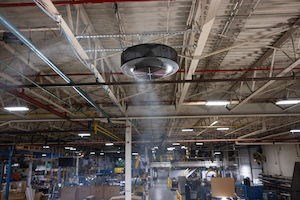 To address the unique challenges of warehouse heating, facilities teams must explore flexible solutions like unit heaters and destratification fans. Doing so can help warehouses achieve reliable comfort without the cost and disruption of a full system overhaul.
For warehouse teams, consistent comfort is a must. Consistent heating is hardly a frivolous perk; rather, it plays a direct role in worker safety and operational efficiency. Cold working conditions increase the risk of muscle strain, slips and fatigue, particularly in physically demanding warehouse roles. Employees who are uncomfortable are also more likely to experience reduced focus, slower reaction times, and lower morale. This, in turn, causes accidents and errors to compound.
From a productivity standpoint, comfortable temperatures help teams maintain a steady workflow throughout the day and across seasons. Reliable climate control also protects sensitive equipment, electronics and stored goods from temperature-related damage, particularly during seasonal shifts.
Why High-Bay Warehouses Are Especially Hard to Heat
With that said, achieving consistency in a high-bay warehouse setting can be uniquely tricky. Several factors make these spaces challenging:
- Large open floor plans
- Thin or inconsistent insulation
- Aging building envelopes
- Outdated HVAC infrastructure
There are also problems that stem from basic physics. Warm air naturally rises, and in a high-bay space, that heat often collects near the ceiling, far above where employees are congregating or working.
It’s also important to remember that older warehouses were typically not originally designed with modern energy efficiency standards in mind. Drafty doors and frequent air exchanges can further complicate temperature control. Retrofitting an entirely new central heating system in these environments can be expensive, time-consuming and disruptive to operations. Thankfully, facilities teams have other options, such as augmenting their aging system with modern add-ons.
Unit Heaters Provide a Flexible Solution
Unit heaters can be an especially practical and cost-effective option for improving heating performance in high-bay warehouses. Rather than replacing an entire centralized heating system, unit heaters can be installed strategically to supplement existing heating infrastructure and address those areas where heating is most essential — and elusive.
Unit heaters deliver localized heat, which makes them ideal for zones where workers spend the most time: packing areas, workstations, loading docks and maintenance bays. They can be mounted strategically, allowing facilities teams to tailor placement based on ceiling height, workflow and space constraints.
They also offer the advantage of scalability. Unit heaters can be added incrementally as the needs of the facility change, making them well-suited for growing operations or seasonal spiked in demand. They also tend to have lower upfront costs compared to centralized system upgrades, along with relatively quick installation times and minimal downtime.
Destratification Fans
Even with an effective heating assembly in place, high-bay warehouses often suffer from temperature stratification, with warm air pooling at the ceiling while cooler air remains at floor level. Destratification fans are designed to remedy this problem by circulating warm air back down into occupied spaces.
By redistributing heat more evenly, destratification fans reduce temperature differences between the ceiling and the floor, improving overall comfort without requiring a significant increase in energy input. In fact, they can sometimes contribute to energy savings, as heaters don’t need to work as hard to maintain the desired temperatures.
In facilities with tall ceilings, pairing unit heaters with destratification fans can be the one-two punch facilities teams need to ensure consistent comfort for their workers, no matter the weather.
Best Practices for Unit Heater Implementation
When selecting and installing unit heaters for a high-bay warehouse, it’s essential to tailor solutions to the needs of the facility. A good place to start is assessing the layout, ceiling height, insulation levels and existing heating capacity of the warehouse. Identifying cold spots and high-traffic work zones will help determine heater placement.
Proper sizing is another consideration. Undersized heaters may struggle to maintain comfort, while oversized units can waste energy and create uneven temperatures. By calculating heating loads, perhaps with guidance from an HVAC professional, facilities team can ensure a correctly-sized unit heater configuration.
Integrating controls such as thermostats or zoning systems can further improve efficiency and allow for better temperature management across different areas of the warehouse. And of course, regular maintenance is a must. Keeping heaters and fans clean and well-maintained ensures consistent performance and extends equipment lifespan.
Choosing the right heating solutions for a high-bay warehouse doesn’t require a full system overhaul.
By understanding the challenges of tall, open spaces and using flexible options like unit heaters and destratification fans, facility managers can improve comfort and safety while keeping costs in check. With smart planning, efficient year-round climate control is achievable even in demanding warehouse environments.
Jamie Tuinstra is a product manager at Modine Manufacturing, where he oversees product development, profit optimization, and customer satisfaction for both new and established product lines. Connect with him at linkedin.com/in/jamie-tuinstra-0a86125a.

INDUSTRIAL SUPPLY MAGAZINE



The September/October issue of Industrial Supply magazine features an in-depth cover story about Rotator Products. Plus, we're featuring articles by contributing writers Dr. Bharani Nagarathnam and Frank Hurtte, as well as interviews with numerous product and distribution industry experts.