


Before you buy another AI tool, fix the sales operating rhythm
A 90-day plan to test whether AI helps your sales team bring dormant accounts back.
By Matt Elliott
Consider an illustrative industrial distributor whose AI flags a machine shop that has stopped ordering. The outside rep recognizes the name. Before calling, she checks whether purchases moved to another ship-to, a project ended, or an unresolved delivery problem sent the buyer elsewhere. Each explanation calls for a different conversation.
Industrial Supply magazine’s recent build, buy, or wait discussion raised an important question about readiness. For sales leaders, that question becomes concrete on Monday morning: how will a recommendation change which account a rep works, and what happens afterward?
A useful next investment may be time spent establishing that routine. Use 90 days to test one application, give sellers a manageable amount of work, and examine the results before expanding.
Days 1 to 30 — Define the account problem
Start with one branch or small team and a specific job: investigate customers who have missed their normal buying cycle. Include a typical seller alongside an early enthusiast. You need to know whether the process works during an ordinary selling week.
Define dormant carefully. A monthly abrasives buyer and a contractor purchasing for indi-vidual projects should not share an arbitrary inactivity threshold. Check customer and ship-to relationships, order dates, current ownership, open quotes, and recent service history.
Confirm when the data was refreshed.
In our example, the machine shop’s orders moved to another ship-to. Correct that record before creating a recovery task. Fix the information this workflow needs; the entire data-base need not be perfect first.
Name the person coordinating each account, including those shared by inside and outside sales. Record the starting reactivation rate and follow-up delay. Agree on what improve-ment would justify the effort, and which existing reporting task this replaces. Fit the work-flow to how your team sells, including how reps obtain account information in the field.
Days 31 to 60 — Review actual accounts every week
Reserve a short part of the existing sales meeting for the accounts under review. Fifteen minutes is a reasonable starting point. Limit assignments to what sellers can investigate and follow through on.
Ask the rep what changed, what the evidence shows, and what the customer confirmed. Then agree on the next action, its owner, and its date. If the recommendation was wrong, record why. A seasonal pause or completed project should not generate the same recovery task next week.
Another flagged shop confirms a delivery problem. The rep works with the branch to resolve it before discussing the next order. The manager checks that the promised fix happened and helps coordinate the people involved.
This review also needs to expose unnecessary work. In one distributor conversation, a leader explained that call-sheet use had tapered off because the process slowed sellers without giving enough back. Requiring more entries would leave that problem intact. Re-move duplicate reporting and keep training tied to practical sales work.
Gallup’s February 2026 employee study found frequent AI use was associated with manager support and fit with existing workflows. Managers should demonstrate that fit through account reviews and useful coaching. Recognize sound investigation, including a justified decision to leave a customer alone.
Days 61 to 90 — Check what changed
Keep the original account definition and observation window consistent. Where practical, randomly phase similar accounts into the new process while others receive usual service. Otherwise, use a comparable group and acknowledge that differences may have other ex-planations.
Check orders, credits, returns, and gross profit in the ERP. An order that was already quoted, a seasonal rebound, or purchases transferred between branches can make the rollout look more successful than it was. Record seller and manager time alongside software costs.
McKinsey’s research associates workflow redesign and defined performance measures with reported AI value. Your own scorecard should show where progress occurs and where work stalls.
A scorecard for the weekly review
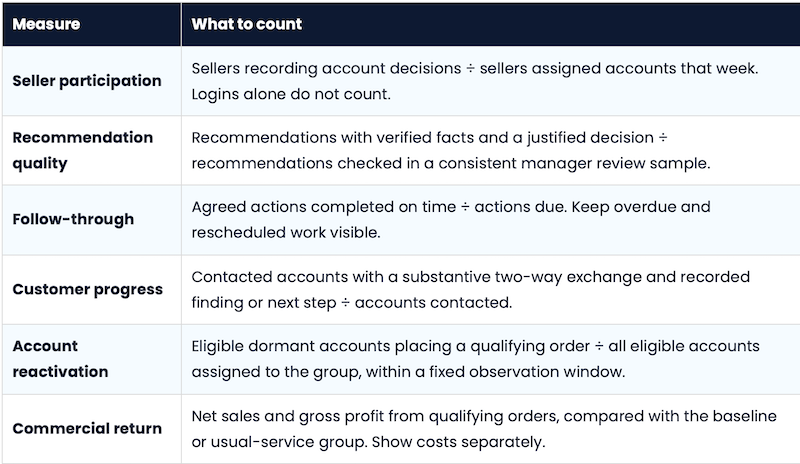
Define a qualifying order before launch. An account ordering again is an observed result; estimating revenue caused by the rollout requires a credible comparison. If the normal reorder cycle extends beyond 90 days, keep tracking it.
Expand when the evidence warrants more investment. If good recommendations are stalling because ownership or data is unclear, repair that problem. If the effort exceeds the value, change the application or stop. Start by choosing one account problem, naming the manager responsible, and putting the first review on the calendar.
Matt Elliott is senior vice president of revenue at White Cup.

INDUSTRIAL SUPPLY MAGAZINE





The September/October issue of Industrial Supply magazine features an in-depth cover story about Rotator Products. Plus, we're featuring articles by contributing writers Dr. Bharani Nagarathnam and Frank Hurtte, as well as interviews with numerous product and distribution industry experts.