

 |
| istockphoto.com |
by Kim Phelan
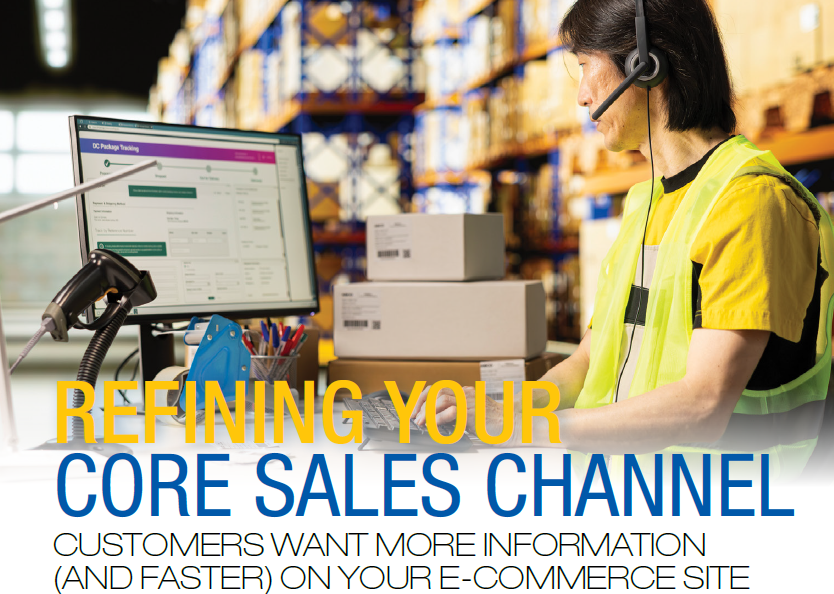
Adoption of e-commerce continues to grow in wholesale distribution, but levels of maturity in the industry is highly varied depending on sector, according to the 2025 The State of E-Commerce published by the Distribution Strategy Group (DSG). At 30% adoption and 15% maturity, industrial distribution is roughly in the middle of the spectrum.
 |
| Quinn |
“Most mid- and large-sized distributors now have something in place – a web storefront, a customer portal, or at least an online catalog. Where they differ is how deeply e-commerce is woven into the business,” said Evelyn Quinn, principal product manager, Epicor Commerce.
“At the leading edge, distributors treat e-commerce as a core sales channel. Their sites are tightly integrated with the ERP, reflect real-time customer-specific pricing and inventory, and are actively promoted by field and inside sales,” she continued. “For these companies, the website carries a meaningful share of order volume and takes a lot of routine work off reps and customer service.”
On the opposite end, some distributor sites function merely as an online catalog. The transaction still happens via quote, email, or phone, often because pricing, contract terms, or data quality haven’t yet caught up online.
Quinn says the “middle of the pack” have solid online ordering, but e-commerce is still an optional channel, not the default. Customers often flip between phone, email, and web, and internal teams don’t always share a unified digital selling strategy.
“Across our Epicor Commerce customer base, we see strong momentum: Once distributors put accurate ERP pricing and availability online and give customers tools like quick reordering and account history, adoption tends to grow quickly,” said Quinn. “The mindset shift is from ‘we need a website’ to ‘we need a digital sales channel that works hand-in-hand with our ERP and our salespeople.’”
Clearly, e-commerce is playing one part in an overall selling symphony for many distributors.
 |
| Baumbach |
“In North America, all our industrial distribution customers have massively invested in an omnichannel presence,” said Werner Baumbach, SAP’s global vice president, wholesale distribution.
And distributors must adapt to customers’ need for speed as well as transparent, easy access to the information they require – but it’s a delicate balance providing product and pricing for the customer who’s got an immediate problem versus protecting your information from your competitors, notes Alex Timlin, SAP chief CRM and customer experience expert. “You don’t want all your information out there, but at the same time, you need a digital front door into what’s going on. We are seeing a lot of people looking at e-commerce as more than just the order taking,” Timlin said. “It’s the product information, the relationship building, and the advice as well, which is one of the main reasons that people are looking for us at SAP to to help them out with a digital business suite.”
 |
| Timlin |
A new generation of tech-savvy customers is far less interested today in the old model of two-hour negotiations over price, according to Baumbach. “They say, ‘give me a good price, and if I like it, I’ll do it,’” he said.
FINDABILITY
Div Makkar, co-founder and CEO of WizCommerce, concurs that one of the most impactful shifts in the distribution e-commerce landscape is the rise of AI-driven “findability.”
“Industrial buyers don’t browse – they want to reach the exact part or solution as quickly as possible,” he said. “Distributors are increasingly adopting AI search and recommendation tools that understand part numbers, attributes, synonyms, and even problem-statement-style queries. When a buyer can type in anything and still land on the correct item, both conversion rates and order size improve.
“AI is helping steer buyers to better-margin alternatives, improve pricing discipline, and shift small, transactional orders toward self-service,” Makkar continued. “Inside sales teams also benefit from clearer visibility into account activity and early signals when buyers are drifting.”
 |
| Makkar |
He adds that distributors are moving away from simple catalogs toward workflow-driven digital experiences. “Customers expect quick reorder from history, pre-built carts for recurring jobs, customer-specific pricing and approval flows, and integrations with their procurement systems. The most effective sites now act more like MRO operational dashboards than traditional storefronts.”
HELP FOR SMALLER DISTRIBUTORS
 |
| Rosado |
Smaller distributors have to find ways to compete effectively in the digital arena. “They need powerful, integrated solutions to level the playing field against major players who have established sophisticated online channels,” said Bill Rosado, account executive at Aldrich Web Solutions.
Tightly linking the e-commerce platform to the distributor’s ERP offers the advantage of reducing manual overhead, automating processes, and ensuring consistent data across the organization, “making the move to digital primarily an efficiency and cost-saving measure as well as a revenue driver,” he added.
Modernizing is necessary to deliver a seamless, B2C-like experience that aligns with the speed and convenience today’s buyers’ demand, says Ralph Sosebee, director of E-commerce at VAI. He agrees that Integration between ERP and e-commerce systems is critical, “ensuring accurate data across inventory, pricing, and order fulfillment. In addition, subscription models and automated reordering are gaining traction, boosting both customer loyalty and predictable revenue for distributors.”
Sosebee adds that AI-driven personalization improves customer experience, tailoring product recommendations and pricing to each buyer, as well as real-time inventory visibility and mobile-first design that enables purchasing anytime, anywhere.
 |
| Sosebee |
Makkar asserts modern e-commerce is less about putting a catalog online and more about using intelligence to guide buyers and drive profitable growth at scale.
NEW DEVELOPMENTS
Sources highlighted new features that are beneficial for industrial distributors.
EPICOR
Epicor Commerce has been focused on three main areas: faster time-to-value, performance and scalability, and deeper integration across the Epicor ecosystem, according to Quinn.
1 ) Epicor Commerce Signature – performance-optimized, low-code storefronts – an SaaS storefront experience designed to help distributors launch or modernize their sites much more quickly. “For our customers, the value is a professional, branded site with deep ERP integration, delivered faster and with fewer customizations to maintain.”
2 ) Product feeds and Google Shopping readiness – Epicor has also been investing in how distributors extend their web catalog beyond their own site, says Quinn. A key area is streamlining product feeds for channels like Google Shopping, so they can: (A) Generate structured product feeds from the same catalog that powers Epicor Commerce. (B) Keep pricing, availability, and product details consistent between their storefront and Google’s Merchant Center or other shopping channels. (C) Reach new buyers and support digital marketing efforts without maintaining a separate stack of tools just for feeds.
3 ) Deeper analytics and automation across the platform – Quinn says the group has enhanced how Epicor Commerce connects with other Epicor technologies:
Analytics. Tighter integration with Epicor analytics tools makes it easier to track key digital KPIs – such as online adoption by account, order mix by channel, and search performance – alongside traditional ERP metrics.
Automation and integration. Through Epicor’s broader cloud platform and low-code integration tools, customers can increasingly automate workflows around web orders, approvals, notifications, and data quality checks. E-commerce becomes a natural, automated part of the end-to-end quote-to-cash process rather than a standalone system.
SAP
1)Timlin says one big challenge with distributor e-commerce is maintaining an enormous price book with customer specific incentives and customer specific terms. “That meant your e-commerce was so vanilla that people would just speak to their salespeople so they get the right price.
“There are plenty of people who have some kind of e-commerce or some kind of portal, but it’s not fully functional because it doesn’t have access to inventory, price and availability. And that’s what the customer’s customer really wants: real-time access to inventory at the right price and the right transparency into ‘can I get it on time at this location?’”
Solution? SAP’s data products. “These are living, breathing data products that can be used in the buy side, in the sell side, and also in supply chain, so that you’ve got real-time access to data and information,” said Timlin. He says this standardized connection throughout the order management layers was the No. 1 priority distributors have pushed for, “making sure that it was cost effective to integrate these different things into an e-commerce portal without needing spaghettis of APIs and integrations.”
2 ) Another problem for distributors: Transferring huge PDF and Excel files of product data in multiple languages.
“We created an AI service that basically just looks at all of the information sources you’ve already got and looks for deltas,” said Timlin. “So, if you get 50,000 new SKUs, you don’t need to go through 50,000 rows of an Excel spreadsheet. We’re looking at which SKU looks similar to other SKUs, what SKU has information already and what’s missing.
“One small distributor saved 15,000 hours a year in having a professional way of managing product information instead of working on spreadsheets.”
3 ) SAP has also created a digital self-service agent that can answer questions like, “Where’s my delivery?” or requests like “Give me a copy of my invoice.” It can also provide very specific product information that could take three or four days for a human to find.
“Distributors’ customers have a big appetite to get fact-based information, 24/7, on a mobile device, without needing to speak to a salesperson, without needing to call into a call center, or without needing to raise a ticket to just get answers that are unusual and uncommon,” he said.
4) SAP has also created a simple AI agentic tool that reads and answers emails and forwards them to the right person. Distributors that receive large amounts of orders through email can automate their inbox first and demonstrate value to themselves even before investing in a full e-ecommerce platform.
 |
| istockphoto.com |
VAI
Sosebee says VAI has introduced a new platform empowering the e-commerce applications, which brings personalized content, improved branding and site customizations, and a completely redesigned CMS.
Deeper, real-time integration between the e-commerce platform and the S2K ERP system are additional benefits.
New mobile-optimized design enhances usability on any device, while expanded self-service features such as order and shipment tracking, invoice payments, and returns empower customers and streamline operations. Strengthened security and compliance measures round out the updates, helping distributors deliver a modern, efficient, and secure online experience.
ALDRICH
Automated Invoice Dunning is a new capability from Aldrich that addresses a critical need for B2B distribution companies: improving cash flow and reducing Days Sales Outstanding (DSO) by fully automating the process of collecting on upcoming and overdue invoices. This moves the Accounts Receivable (AR) function from a manual, time-consuming effort to a strategic, automated system.
The core of the feature is an automated email series that systematically reminds the customer’s Primary Contact (as listed in your ERP) about their invoice obligations.
Each dunning email provides the distributor with everything they need to take immediate action, reducing friction in the payment process: (1) A clear message stating whether the invoice is upcoming or overdue. (2) The invoice number and the amount due. (3) A PDF copy of the invoice attached for their records. (4) A direct link to pay the invoice online.
“In summary,” said Rosado, “this new Invoice Dunning – Email Automation capability is a powerful tool that drives financial efficiency by turning a manual Accounts Receivable task into a strategic, set-it-and-forget-it automated process, leading to improved cash flow and better collection success rates.”
WIZCOMMERCE
Ella, is the company’s AI order-entry agent, which reads emailed PDFs, spreadsheets, portal downloads, and even photos of handwritten orders. Ella extracts line items, matches them to SKUs and pricing in the ERP, validates quantities, and creates a clean, ready-to-approve order in seconds – reducing errors and response time.
On the website, WizCommerce’s AI search interprets part numbers, attributes, synonyms, and problem statements, then surfaces the right items, recommends compatible products, and suggests stronger alternatives.
“Together, Ella and AI search help distributors capture more digital orders, increase average order size, and deliver a smoother, more accurate buying experience that aligns with how industrial customers already operate,” said Makkar.
This article originally appeared in the January/February 2026 issue of Industrial Supply magazine. Copyright 2026, Direct Business Media.

INDUSTRIAL SUPPLY MAGAZINE




The September/October issue of Industrial Supply magazine features an in-depth cover story about Rotator Products. Plus, we're featuring articles by contributing writers Dr. Bharani Nagarathnam and Frank Hurtte, as well as interviews with numerous product and distribution industry experts.