
 |
by Kim Phelan
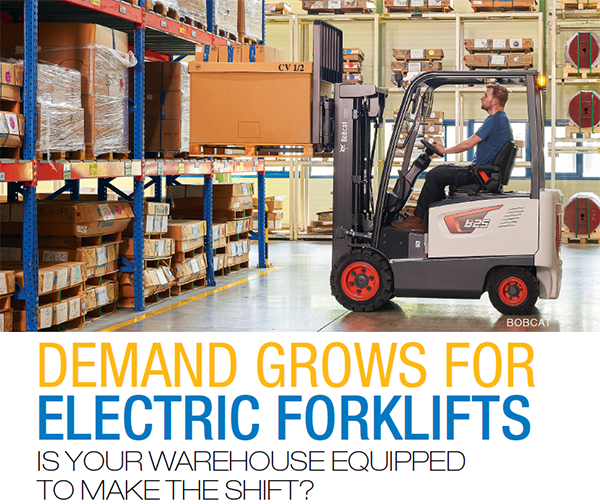
The forklift industry is experiencing a significant shift driven by the demand for greater uptime, lower emissions and smarter, safer operations. According to Andre Marshall, senior product manager at Bobcat, electrification – particularly the move to lithium-ion batteries – is one of the most influential forces in today’s market. Lithium-ion delivers longer battery life, making it well-suited for multi-shift warehouses and high duty cycles.
Marshall emphasizes that selecting the right forklift starts with aligning equipment choices to an operation’s energy strategy. Distributors should evaluate whether lithium-ion battery technology or hydrogen-ready solutions best suit their fleet size, shift structure and sustainability goals.
Lithium-ion provides strong life-cycle value and low maintenance, while hydrogen is ideal for demanding, multi-shift operations that rely on quick turnaround times, he says.
Ease ownership is another key factor for distributors to consider, which sources say is influenced by maintenance accessibility, parts longevity, reliability and productivity of the forklifts, charging or refueling infrastructure, telematics capabilities, and dealer support before, during and after the sale. Marshall notes that connected technologies like fleet-management platforms, predictive-maintenance tools, and integrated diagnostics help maximize uptime, streamline service and provide the data needed to optimize fleet performance.
Martin Boyd, chief marketing officer at Big Joe Forklifts, agrees that one of the most discussed trends in the material handling world today involves electrification — or more explicitly, the transition from internal combustion (IC) powered forklifts to electric and automation.
 |
“When you look at the material handling industry overall, it’s quite clear that the electric mix has been consistently trending upwards for over half a century,” Boyd said.
“But a deeper dive will reveal the drive behind that steady increase as a percentage of overall lift truck sales was due to an expansion of warehouse and distribution centers, where electrics primarily operate. Stripping out electric powered warehouse lift trucks, it could be seen that the movement from IC to electric has remained relatively flat, that is until recently.
“Today the industry is experiencing a rapid adoption rate of electrics over IC,” Boyd continued. Why is that? The answer is simple: lithium-ion batteries. The entrance of industrial lithium-ion batteries and advancements in charging technology have combined to finally give customers a solution that enable them to make the switch to electric without experiencing all the pains that came along with traditional lead acid battery systems.
Where there is an electric forklift, there is need for power optimization, says Luca Ghiotto, manager of product marketing for Mitsubishi Logisnext Americas. “Every distributor has unique needs and pairing the right battery with the right charging solution to meet their application requirements.”
Automation is another major driver, according to Marshall. “Warehouses are increasingly blending traditional forklifts with semiautonomous technologies, AI-enhanced sensing systems, and automated material movement solutions,” he said. “These advancements help reduce repetitive tasks, support labor-challenged operations, and allow employees to shift toward more value-added responsibilities.”
Boyd adds that with labor constraints continuously challenging distributors today, there has been a growing demand for semi-autonomous and fully autonomous solutions designed to address many of the headwinds created from workforce reductions. “The need for simple, yet flexible and scalable solutions that leverage the latest in embodied AI technology is paving the way for a new age in material workflow and movement,” he said.
 |
NEW FEATURES AND BENEFITS
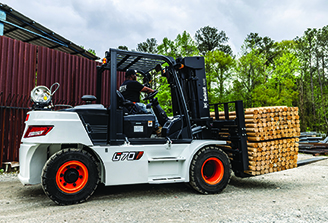
Big Joe Forklifts. Boyd says the organization takes pride in its history of being an industry disrupter with a unique ability to develop innovative solutions that directly address some of the biggest pains and challenges the market faces. Big Joe’s continued focus on introducing new integrated lithium, counterbalance forklift models which aim to lead the internal combustion to electric (IC to E) movement is really building momentum in North America. Big Joe has recently expanded its offering of purpose-built, integrated lithium-ion forklifts with the introduction of high performance 8,000- and 10,000-pound capacity pneumatics as well as a new 6,500-pound capacity cushion tire model, all designed as a direct replacement for LPG and diesel powered equipment.
In addition to the introduction of new electrification forklift models, Big Joe is developing tools to help drive the IC to E trend. Unlike the automotive sector, the IC to E opportunity in the industrial forklift market requires a deeper study to ensure an electrified solution will work in the operation. Does the facility have the appropriate infrastructure to power all the forklift chargers? What is the appropriate sizing for both truck batteries and chargers? Where should the chargers be installed throughout the facility? Are the operators trained appropriately on when to charge the trucks?
“All of these questions must be addressed before an electrified solution can be deployed, and all of these questions require facts, not guesses,” said Boyd. “Big Joe Pulse is the tool for which these questions can be answered. Pulse is Big Joe’s telematic tool which relays all the pertinent information from the Big Joe truck, back to the dealer. Data such as how much energy is being consumed throughout a shift, when the truck is being charged, how quickly the truck is being charged, etc., are then utilized with the customer to ensure they will be set up with the optimal solution for their specific operating environment.”
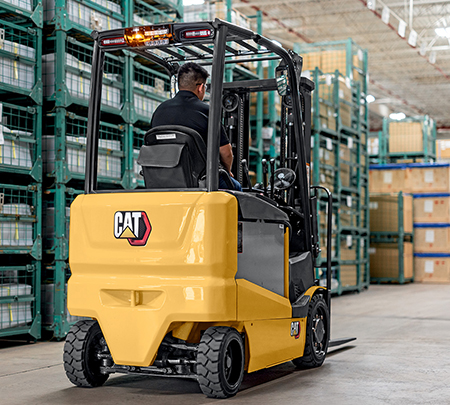
Bobcat. Marshall cites several advancements across the company’s forklift lineup that help customers improve productivity, reduce downtime and support evolving energy needs. For example, hydrogen-fuel-cell-ready forklifts provide a pathway for facilities interested in fast-refueling and zero-emission technology that supports demanding multi-shift operations. “We’re expanding our lithium-ion offerings as well,” he said, “with models engineered for high-duty warehouse use that require less maintenance, deliver rapid opportunity charging and support consistent performance across long shifts.”
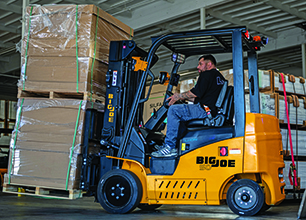 |
Additionally, Bobcat introduced new models featuring redesigned drivetrains and hydraulic systems. “Across the lineup, we’ve strengthened safety and operator-assistance systems by adding optional pedestrian- and object-detection technologies, advanced LED lighting packages, intuitive controls, visibility enhancements and operator-sensing features designed to promote safer and more efficient operations,” Marshall said.
Mitsubishi Logisnext Americas. Ghiotto says the company’s focus has been on launching new products and services aimed at lowering costs and improving operations for our customers. This includes: (1) telematics to optimize fleet performance and automate manual processes; (2) operator assistance solutions including Object Assist and ZoneControl that give the operator additional tools to do their jobs more efficiently; and (3) the Q Series mid size electric cushion forklift that is designed to deliver maneuverability, productivity, and energy efficiency for demanding indoor applications.
This article originally appeared in the March/April 2026 issue of Industrial Supply magazine. Copyright 2026, Direct Business Media.

INDUSTRIAL SUPPLY MAGAZINE

The September/October issue of Industrial Supply magazine features an in-depth cover story about Rotator Products. Plus, we're featuring articles by contributing writers Dr. Bharani Nagarathnam and Frank Hurtte, as well as interviews with numerous product and distribution industry experts.