

The cutting tool category is changing — distributors who lead with safety will win
By Jarrod Streng
For decades, the cutting tool was the most overlooked item on the jobsite. Every worker had one. Every safety manager assumed it was handled. And every year, lacerations remained one of the most common, and most expensive, recordable injuries on the floor.
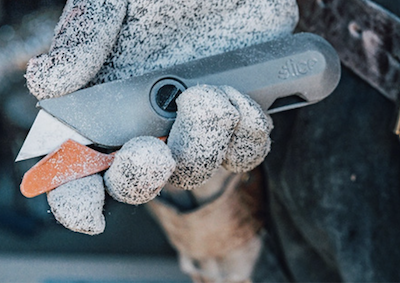 In many facilities, cutting happens hundreds of times per shift, yet the tools themselves are rarely reviewed with the same rigor as other safety equipment or PPE.
That's starting to change. Across manufacturing, distribution centers, food processing, construction, and retail, end users are reevaluating the cutting tool not as a commodity, but as a piece of safety equipment. The question is no longer whether a knife cuts well. It's whether the knife is doing its part to send the worker home, safely.
For distributors and independent manufacturer reps, this shift is the single biggest category opportunity in MRO and industrial supply today. And the distributors who recognize it early are going to own the conversation for the next decade.
A Category That Has Quietly Transformed
What’s accelerating the shift now is pressure from multiple directions at once. EHS teams are under increased scrutiny to reduce recordables. Operations leaders are being asked to maintain throughput with fewer disruptions. Procurement teams are reevaluating total cost of ownership instead of upfront unit price. And insurers are paying closer attention to preventable hand injuries that continue to drive claims frequency.
Industry data places the average cost of a single laceration injury at roughly $46,000 when medical costs, lost time, recordable impact, and indirect productivity losses are included.
Concealed-blade designs that were once considered specialty items are now standard issue at major distribution centers, food and beverage operations, and retail backrooms. Auto-retracting and spring-back mechanisms have replaced fixed and snap-off blades in facilities that wouldn't have considered them five years ago. Finger-friendly ceramic blades have moved from niche packaging applications into mainstream healthcare, warehouse, and consumer environments. The common thread is engineered safety. The cutting tool itself is now expected to reduce exposure, not simply perform the cut.
This isn't a marketing trend. It's a category transformation, driven by EHS leaders who've run the numbers, insurers who've raised the stakes on recordables, and operations managers who've connected the dots between safer cutting and uninterrupted throughput.
What the End User is Actually Asking For
When we talk to safety and operations leaders today, the conversation rarely starts with the knife itself. It starts with three questions:
- First, can I reduce my recordables without slowing the line? The strongest safety knives on the market today are engineered to match or exceed the cut performance of a traditional utility knife. The performance trade-off that defined this category for years is no longer the trade-off it once was.
- Second, can I standardize across applications? Most facilities have a mix of cutting tasks, corrugate, strapping, film, shrink wrap, gasket material, and have historically met that mix with a drawer full of mismatched tools. End users are increasingly asking distributors for a curated, application-matched cutting program rather than a SKU list.
- Third, can I prove ROI to my CFO? Safety conversations that used to live in the EHS office are now happening in finance reviews. Distributors who can frame cutting tools in terms of avoided recordables, reduced product damage, and lower total cost of ownership are winning bigger and stickier programs than those still selling on unit price.
What This Means for the Distributor Channel
Three things are true at once. The category is growing. The conversation is getting more sophisticated. And the bar for being a credible advisor in this space is rising.
Distributors and reps who lean in have a real advantage. The ones who treat cutting tools as a line item, restocked when the bin runs low, are going to lose share to the ones who treat the category as a safety solution.
Practically, that means a few things:
1) Lead with the audit, not the catalog. The fastest way to open a serious cutting program conversation is to walk a customer's facility and identify the cutting tasks happening today, the tools being used for them, and the mismatches. Most facilities are surprised by what they find.
2) Sell the vend-ready system, not the SKU. A safety cutting program is rarely a single tool. It's a matched set, the right cutter for each task across a facility, chosen deliberately rather than pulled from a drawer of mismatched knives. A well-designed safety cutter does real work in that set, with concealed and auto-retracting blades and finger-friendly construction. But a single tool, however good, is still a single tool. Distributors who help customers build the program, organized around how work actually happens rather than around part numbers, are the ones making a catalog genuinely vend-ready.
3) Bring data to the table. End users respect distributors who can quantify the problem. Average laceration cost, recordable rates, product damage benchmarks, and ROI math turn a transactional conversation into a strategic one.
The Next Five Years
The category is moving in one direction. Concealed-blade and auto-retracting designs are becoming the default specification at large end users. Safer ceramic blade technologies are expanding into applications no one would have predicted five years ago. Metal-detectable cutting tools are becoming non-negotiable in food and beverage. And the conversation about whether cutting tools should be considered personal protective equipment is moving from trade publications into procurement specifications.
Distributors and reps who are positioned as cutting safety experts, not just cutting tool suppliers, will be the ones writing the multi-year programs. Those who aren't will spend the next five years defending price on a shrinking traditional category.
Safety has evolved. The cutting tool category has evolved with it. The opportunity for the channel is to lead the conversation, not catch up to it.
 Jarrod Streng is president and CEO of Safety Products Global, a portfolio of safety cutting tool brands including Klever, Slice, and Pacific Handy Cutter. SPG products are distributed through industrial supply and MRO channels across North America.

INDUSTRIAL SUPPLY MAGAZINE
The September/October issue of Industrial Supply magazine features an in-depth cover story about Rotator Products. Plus, we're featuring articles by contributing writers Dr. Bharani Nagarathnam and Frank Hurtte, as well as interviews with numerous product and distribution industry experts.