


Becoming a Formidable Force
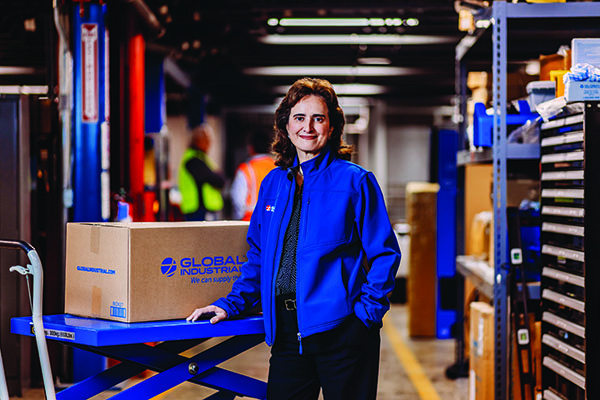 |
| Anesa Chaibi, CEO of Global Industrial Company |
Nearly 18 months into her role as CEO of Global Industrial Company, Anesa Chaibi has charted large directional strategies aimed at one destination: being the top-of-mind solutions provider in the industrial/MRO space.
by Kim Phelan
If Anesa Chaibi is in the driver’s seat of a business, it’s a sure bet she knows where she’s going, and she’s got her foot on the gas. It’s also likely the company will no longer remain merely on the map — it will evolve into a force to be reckoned with.
Chaibi had already been a leader at two publicly traded “household name” companies by the time she accepted Global Industrial Company’s offer to become chief executive officer in February 2025. A chemical engineer by training who worked in various GE technical businesses for 16 years, Chaibi built her own career bridge from science to executive management and crossed into industrial distribution in 2005 as president and CEO of Home Depot Supply – MRO, which later became HD Supply Facilities Maintenance.
 |
Fast forward to 2025: While 76-year-old Global Industrial, also a public company, possessed a rich history, strong culture, and a robust line of its own exclusive-brand products, Chaibi was not content to leave the business at status quo.
She traded San Diego, California, for Port Washington, New York, in the middle of winter and got to work. Top priority was to visit all of Global Industrial’s distribution centers and worldwide teams, listening to management and employees and assessing the whole picture from every angle. A self-described action-oriented leader and direct communicator, Chaibi quickly determined this company should be top of mind for every buyer in the industrial/MRO sector.
Before 2025 came to an end, she targeted four big initiatives she believes will alter the course of Global Industrial in the distribution marketplace: (1)emphasizing customer centricity; (2)guiding the CRM migration to Salesforce; (3)rewriting the go-to-market playbook, and (4)developing a strategic account focus.
“There’s a much broader opportunity for Global Industrial — it’s like we are a hidden gem,” she said. “We could do a better job of reinforcing who we are, what we do, and attracting the right customer base that we’re leaning into with all our priorities and initiatives.
“We are making the right investments to scale and grow the business and evolve it,” she continued, “and in the coming years, we’ll become a much larger, well-known, and formidable force. And if we do this right, we’ll be better understood in our capabilities and what we take to market. It will be driven by an engine of an incredibly strong culture of people who want to serve our customers in a meaningful and positive way.”
SUCCESS BEGETS SUCCESS
 |
Six weeks after joining Global Industrial, Chaibi was confronted with a supply chain crisis. President Trump declared April 2 “Liberation Day,” and the rollercoaster known as tariffs was flipped on at high speed. For a company whose offering includes many products made from steel and aluminum, the sense of urgency for the distributor was tremendous.
“That priority moved immediately to the front of the line, and the organization reacted incredibly well,” said Chaibi. “We had a significant concentration in a given country of origin that was overly tariffed — the team quickly figured out where to find other sources of supply to help mitigate that risk, and despite the challenges, we overcame all of that to deliver a solid year all around.”
It may have been the team-building exercise Global Industrial needed to regroup and get behind its new leader. But even without the trade policy scramble, Chaibi was intentional about building buy-in and creating wins.
“This is a fantastic culture with people who want to win and want to do the right thing to serve our customers,” she said. “What I saw was an opportunity to refresh the mission, vision, and values of the company to become even more customer centric and responsive — the organization already was, but now we’re taking it to the next level.”
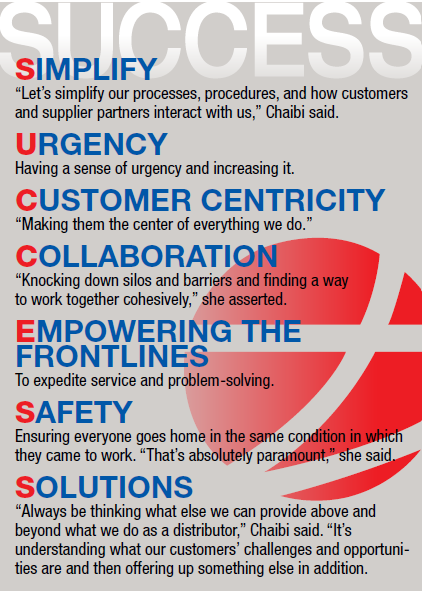
Good slogans can help people catch a new vibe, and Chaibi gave her team two. She said if you walk into Global’s facilities today, the new mission is proudly on display: “One team enabling customer success by delivering value.” The team also created an acronym to punctuate what the company is now fixed on: SUCCESS.
“SUCCESS is easy to remember, and we’ve found that it has resonated throughout the organization with all our teams everywhere,” she said. “I have a philosophy that success begets success. If you get a taste of it, the team gets energized. You have some wins, you get excited about it, and you lean into it even more. That’s been my experience, and I’m seeing the culture here start to really gravitate to that.”
It’s evident that Chaibi believes success is a team sport. She says she wanted to give the Global Industrial team confidence to try things, and indeed they have piloted and tested some new ideas. Approachable and accessible, Chaibi says she wanted the employees of the company to know she’s got their back and wants them to innovate.
“I wanted them to stretch, and the culture is amenable to that, which is fantastic,” she said. “I will say that the organization was a little timid in the beginning, but now they’ll fearlessly try things,” she said. “Nothing egregious, but they’re willing to test new things.”
 |
DRIVING CHANGE TO DRIVE MORE WINS
By inviting team contribution and innovation, Chaibi has in turn received internal adoption for her large directional changes, which are concurrently being executed at Global Industrial.
1) Customer centricity. Chaibi has set in motion a continuous loop of customer feedback and consistent touchpoints to help the distributor shape and prioritize how it will serve customers better. “It’s using real, candid, and honest feedback to drive the organization to react and respond,” she said.
Disciplined about data, the company maintains a high Net Promoter Score and consistently combs through customer feedback in pursuit of new opportunities to improve on its execution — at the customer level. In tandem with Global Industrial’s rigorous responsiveness to surveys, Chaibi emphasizes listening to customers face-to-face.
“I’m a leader who manages by walking around — I don’t just sit in my office. I’ve gone out with the sales team and visited customers … I’ve asked them, ‘What can we do better?’ or ‘Did you know that we offer X, Y, and Z product?’ And in many cases, we’re hearing, ‘Well, no, I had no idea, because I only know you for this category or this product line.’ So, we are getting to the root cause and driving the corrective actions and moving through it not with emotions or anecdotes, but with facts and data.”
2) Switching the CRM. The purpose was two-fold: Simplify employee access to information (cue the first S in her SUCCESS acronym), and leverage information in real-time to better understand their customers. Essentially, Chaibi sees the move as an extension of the customer centricity focus.
Migrating away from a homegrown system that still exists in parts of the company, Global Industrial invested in Salesforce last year, and Chaibi says they’re progressing well in the rollout to sales, marketing, and customer service.
“We’re evolving and getting smarter with how we utilize it,” she said. “The team has embraced it and they welcome it. There was a learning curve in the early days, like with all change; it’s figuring out what we need to do differently to use this information to better serve the customer. We’re probably going to add elements of AI to it as we go forward, but we’re bringing the right information, real time, to the fingertips of those trying to respond to the customer. And we’ve gained some productivity — the flow of information is more efficient.”
3) Go-to-market approach. Indeed, visiting customers has yielded meaningful intelligence. Specifically, Chaibi reiterated how walk-throughs at different customer facilities revealed that decision-makers (A) weren’t aware of Global Industrial’s breadth of product offerings and (B) they were all interested in having alternative providers for certain products they currently buy.
“That really helped formulate our go-to-market strategy — and for me, from a strategic perspective, it was about marketing, merchandising, and sales. These organizations already work well together, but there was a way to streamline it.”
Chaibi has shifted the company from an inside sales-focused model to introduce an outside sales component. In addition, she has realigned sales teams to serve specific verticals. “They’re becoming much smarter about customer needs in their segment,” she said.
Like a marching band conductor, Chaibi brought three key business departments into synchronized step with each other — merchandising has piloted new product categories and SKUs, marketing contributes with the right collateral and value proposition, and a new outside sales force works the frontlines to both identify opportunities with existing accounts and attract new customers.
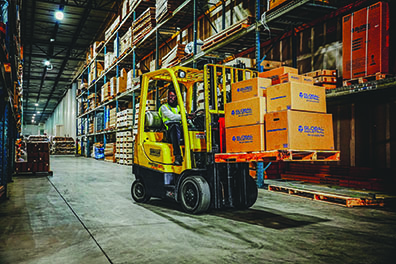
4) Strategic account focus. Far from abandoning inside sales, Chaibi merely adjusted the lens. Global Industrial has targeted behemoth Fortune 500 companies that are primarily served with a dedicated inside-sales point person.
 |
“It’s about establishing relationships and becoming stickier,” she said. “And quite frankly, what I envision and what we’re striving to do over time is to become so valuable to them that we are an extension of their team.
“The team already had very strong strategic accounts and managed them very well,” she added. “What we want to do is to have more touches, more people to be able to capture greater share of wallet by addressing customer needs, because they are evolving as the marketplace evolves.”
CHANGE IS THE ONLY CONSTANT
Creating major change within the first year-and-a-half at the helm wouldn’t be every leader’s MO, but Chaibi came in with courage and conviction to face market realities and adjust necessary levers to drive the distributor’s profitability and visibility.
“The industries that we serve, whether they’re construction, manufacturing, warehousing, and beyond, are constantly evolving,” she said. “There’s automation, there’s digitization, there’s labor constraints; there’s a whole bundle of things that are constantly shifting every day. Within industrial distribution, we need to stay close to these shifting trends and anticipate customers’ changing needs — and be ready to adapt and be nimble and flexible.
“Change is the only constant, and we need to embrace it and continuously improve and revisit our approaches to ensure that we’re aligned with what our customers and the marketplace want. That becomes the differentiator for each of us as distributors: Making sure that we’re on point. We must be clear who we’re serving, understanding their needs, and then doing that as effectively and as cost-efficiently as we can.”
This article originally appeared in the July/August 2026 issue of Industrial Supply magazine. Copyright 2026, Direct Business Media.

INDUSTRIAL SUPPLY MAGAZINE


The September/October issue of Industrial Supply magazine features an in-depth cover story about Rotator Products. Plus, we're featuring articles by contributing writers Dr. Bharani Nagarathnam and Frank Hurtte, as well as interviews with numerous product and distribution industry experts.