
Robotics & Automation Q&A Series, Part 4
Following is the latest installment of our expansion from Industrial Supply Magazine's July/August issue covering robotics and automation for industrial distributors. This week's Q&A is with Logisnext's Michael Bloom, director, connected solutions, and Michael Brunnet, senior manager, warehouse and systems truck sales.
 |
 |
| Michael Bloom | Michael Brunnet |
Industrial Supply: What are the 1–3 biggest trends in warehouse robotics and automation today, and what’s driving them?
Michael Bloom: (1) A practical, phased pathway toward full automation. While full warehouse automation remains a long-term objective for many organizations, not all companies are ready or able to implement fully autonomous operations today. Fully autonomous systems are expensive, complex, and often impractical to retrofit into existing manual facilities. As a result, many operations are pursuing stepwise approaches that improve efficiency now while preserving flexibility for the future.
(2) Growing demand for intelligent operator-assist technologies. For companies that are not ready for autonomous operations, work place safety remains a critical objective. Intelligent operator-assist systems are designed specifically for these environments and to support achieving those objectives. Rather than replicating full automation, they provide a stepped-down but highly effective set of capabilities focused on supporting safe operating practices and operational efficiency—maximizing what is possible while keeping operators fully in control of the truck. This approach directly addresses the realities of manual and mixed-traffic warehouses where operators remain central to daily operations.
(3) Targeted intervention instead of full-facility coverage. Another key trend is the shift away from solutions that require full facility coverage—such as traditional RTLS-based systems—in favor of targeted intervention. Full-coverage systems can be costly and often apply controls even in low-risk areas where they add little value. Targeted intervention delivers the same core benefits— supporting safe operating practices, traffic control, and efficiency improvements—but only in the areas that matter most, such as intersections, dock zones, pedestrian crossings, and other high-traffic locations. This enables operations to focus investment where it has the greatest impact.
IS: What do you recommend distributors should think about and investigate before investing in robotics/automation for their warehouse operations?
Michael Brunnet: Be clear about the operational problems you are trying to solve—and how you plan to measure success.
Distributors will often benefit from reviewing documented incidents, or near misses, that have occurred within the facility and analyzing them over time. Mapping or “heatmapping” these events can help reveal patterns where specific locations—such as intersections, dock areas, or pedestrian crossings—can present higher levels of risk. This type of analysis can be a useful way to focus investments where improvement opportunities are most meaningful.
It is also helpful to identify the specific KPIs an operation is hoping to influence with operator-assist technologies, whether that involves incident rates, near misses, congestion, equipment damage, or productivity impacts related to these events. Just as importantly, companies should consider upfront how those KPIs will be monitored, measured, and reported after implementation. This step is often underestimated, yet it plays a critical role in validating improvement. It’s an area the Logisnext team routinely highlights and helps define when working with customers on operator-assist deployments.
Bloom: Evaluate how much coverage is really necessary. Not all operator-assist solutions require the same level of infrastructure. Some approaches, such as traditional RTLS systems, may require full facility coverage, adding cost and complexity even in areas where risk is relatively low. Distributors may want to explore whether targeted solutions can deliver comparable benefits—such as risk mitigation, traffic management, and efficiency improvements—by focusing on the areas that matter most.
Also, ensure the solution aligns with real-world, manual operations. For most warehouses that continue to rely heavily on human-operated forklifts, technologies are most effective when they are designed with operators in mind. Solutions that can provide real time awareness, when the operator is distracted or too slow to respond, giving them more time to react, intervene selectively, and preserve operator control tend to integrate more naturally into existing workflows. Systems that minimize unnecessary interventions are also more likely to gain operator acceptance and deliver consistent results.
And consider scalability and future flexibility. Finally, distributors may want to consider how any investment can support both near-term operational needs and longer-term goals. Solutions that are adaptable to layout changes, scalable across fleets or facilities, and capable of evolving over time can offer greater flexibility as operations continue along their automation journey.
IS: Please describe one new and/or innovative product or technology your company has recently released. What are its highlights?
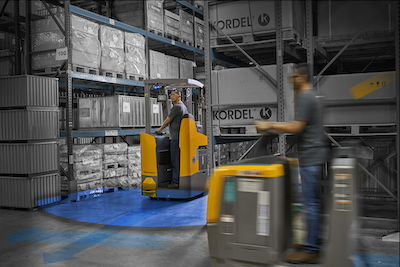 |
Bloom: Object Assist and zoneCONTROL from Logisnext are intelligent operator-assist technologies designed to help warehouses achieve their safety goals, by reinforcing safe operating practices, and operational efficiency in manual and mixed-traffic environments, while keeping operators fully in control of their trucks.
For the vast majority of companies that are not willing or able to implement fully autonomous operations at their current stage of warehouse evolution, these solutions provide a practical path to capture meaningful automation benefits today. Instead of requiring a shift to full autonomy, Object Assist and zoneCONTROL focus on targeted risk mitigation, traffic management, and efficiency improvements in environments where human operators remain central to daily operations.
Object Assist uses a 2D light beam to monitor a forklift’s predicted travel path in real time, taking into account steering angle and vehicle speed. When an object or pedestrian enters that predicted path, the system can alert the operator and automatically slow the vehicle to crawl speed, providing additional time to react and help avoid a potential incident. By focusing on the forklift’s actual travel path, Object Assist helps reduce false positives and unnecessary slowdowns, supporting both safety and productivity.
zoneCONTROL is an intelligent geofencing solution that uses precise UWB technology to create defined zones within a facility where forklift behavior—such as speed or access—can be automatically adjusted. These zones are typically applied in higher-traffic areas such as intersections, dock doors, pedestrian crossings, charging stations, and staging areas.
zoneCONTROL can also be configured to trigger connected devices such as lights, alarms, and physical controls—including the ability to open or close gates or doors—allowing operations to apply targeted interventions without requiring full-facility coverage.
Together, Object Assist and zoneCONTROL enable companies to apply the right level of automation for where they are today—helping to achieve their safety objectives and efficiency goals while preserving flexibility for future advancements.

INDUSTRIAL SUPPLY MAGAZINE
The September/October issue of Industrial Supply magazine features an in-depth cover story about Rotator Products. Plus, we're featuring articles by contributing writers Dr. Bharani Nagarathnam and Frank Hurtte, as well as interviews with numerous product and distribution industry experts.