

Wired For People
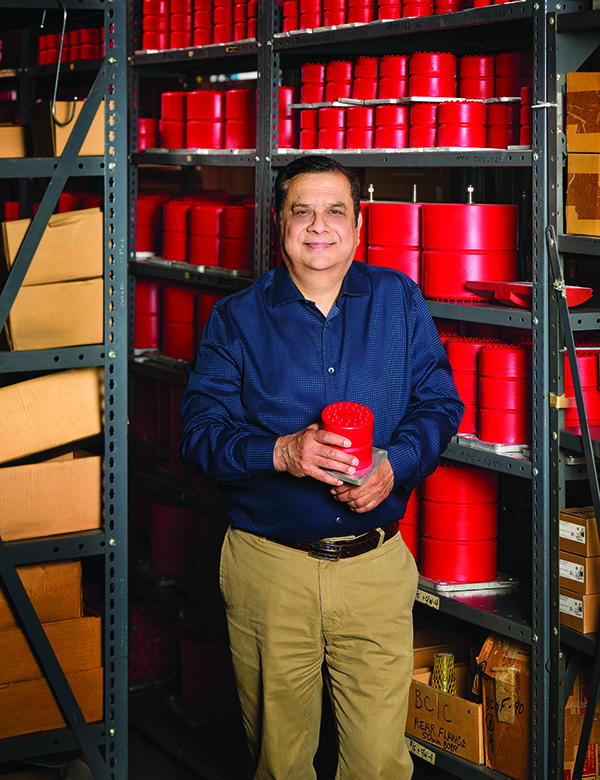 |
| Ajay Bajaj bought Rotator Products in 2001 and has since doubled its revenues. |
Ajay Bajaj uses engineering savvy and a knack for relationships to grow Rotator Products.
by Kim Phelan
In 1984, Americans were occupied with cultural events like the Los Angeles Olympics, Ronald Reagan’s presidential victory, the launch of the Apple Mac, and “Ghostbusters” becoming a big-screen blockbuster. To the North, Canadians celebrated the Edmonton Oilers’s Stanley Cup victory, saw the first woman become Governor General, and watched the first Canadian travel to space. But far, far away from North America, life was hard in India. Even before the October assassination of Prime Minister Indira Gandhi and the surge of violence that followed, the country was burdened by a socialist economy characterized by limited consumer choices and many state-run enterprises. The contrast between the societies was dramatic.
That year, many citizens immigrated to Canada in search of a better life defined by hope and opportunity. Two of them were Ajay Bajaj from Delhi, (current owner of Rotator Products in Woodbridge, Ontario), and his new wife, who had previously resided in Vancouver, which is where they first settled. Bajaj, a young engineer in his early 20s, had about $30 in his pocket when they arrived to the “Land of Maple,” but he was soon able to land a position with a manufacturer in Canada’s most western province.
When time drew near for the couple’s first baby to arrive, the young Mrs. Bajaj wanted to relocate to Toronto to be closer to her family, and so Ajay’s job search ensued with the help of a headhunter. An ideal position was open at Rotator Products, a power transmission distributor founded by a crane engineer in the ’70s — but alas, they’d already shortlisted their final candidates. The door was closed before Bajaj could get a foot in, or so it seemed.
“I said to the headhunter, ‘Give me the name of the president of the company — I’ll give him a call so he at least remembers me if there’s any opportunity in the future,” Bajaj recalled. “We talked on the phone, and I said I would love to have a coffee and spend five minutes with him. He was busy so we arranged to visit at 7 in the morning. I drove across town — we were at that coffee shop till 10 o’clock! They ended up withdrawing another offer and gave me the job.”
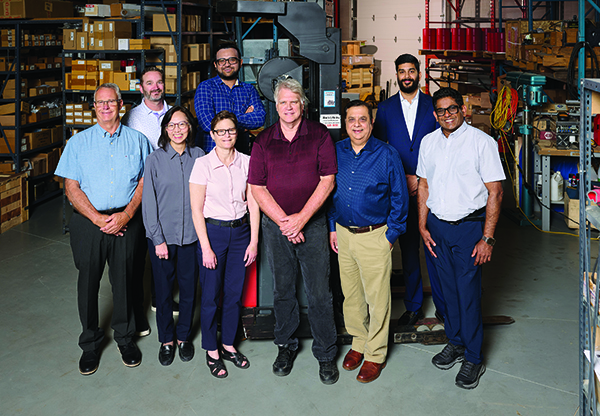 |
| Bajaj and his team push the envelope on innovative solutions, which has strengthened the company’s position in key markets including wastewater treatment, metals, power generation, mining, and material handling. |
MAKING THE LEAP
While serving a dual role as manager of engineering and sales, Bajaj attended night school at University of Toronto to earn a mechanical engineering degree and P.Eng. designation, which he added to his professional engineering credentials from Punjab Engineering College in India. Over the next 15 years, he took on jobs of increasing responsibility at Rotator Products until he was virtually running the company.
Turns out, his leap from engineer and management to entrepreneurship had been the plan all along. “From Day 1, I wanted to own my own business, and I genuinely enjoy meeting people,” he said. “Of course, you get good ones and bad ones, but I just enjoy interacting with people. Even as an engineer, my roles after the first couple of years were customerfacing, so that gradually attracted me into application engineering and sales engineering, where there’s a lot of focus on meeting customers. I always looked forward to going to work, even on a Monday.”
In the late 1990s, he made known his ambition to be the next owner of the company, even well before the owner was ready to retire. But finally, Bajaj acquired Rotator Products in 2001 — and a week later, terrorists attacked the U.S. on Sept. 11.
“It was the worst time to buy a business,” he reflected, “and the owner was very understanding. He said, ‘You can back out if you want and reconsider in a couple of years.’ I said no. I will sink or swim. For the three months after 9/11 the business fell off a cliff, but we came back with a bang, and I took the company into a slightly different direction.”
Bajaj had already instilled into the company’s five employees that they and Rotator Products were more than mechanical engineering. They were an engineering solutions company.
“We became a mechanical, electrical, and automation company. There are very few companies who can do all three. The automation and electrical people don’t usually venture into the mechanical side of things. Fortunately, by training for the product lines we had brought in, we developed the expertise within the company and our people to master them all. It made us very well rounded and unique in our industry. I think it was one of the best things that we could do.”
One of many examples of their capabilities occurred five years ago. “An international pump company in Hamilton, Ontario, was installing a new water treatment plant, and they needed pumps and motors and everything,” said Bajaj. “But the distance between the pump and the motor was about 57 feet vertically. They needed to connect the motors and drive the pumps, which were well over 1,500 horsepower. We came up with the solution to make a 57-footlong coupling. Because it was 57 feet, it would be very heavy, so the question was, how do you transport it? We designed it in four sections made of carbon fiber, which is used in aircraft — our system supported all the weight at different floors so that the weight of the whole shaft was neither on the motors bearings nor on the pump bearings. It was made in segments, each balanced to very strict specifications. It was a first in Canada, and a feather in the cap for the pump company that worked with us.
“Since then, for every Canadian pump company that has an application like that, we are the first ones invited to consult and bid … It was a very unique project, and since then we have done the city of Winnipeg, we have done Montreal, as well as a lot of other cities.”
Today, not surprising, wastewater treatment plants are on the company’s Top 5 list of most profitable sectors served. The others are metals (especially steel mills); power generation, from hydro power (aka dams) to nuclear; mining (which he says is booming in North America, including minerals, lithium, metals, and rare metals); and material handling (as in the cranes and ports side of the business in Texas).
SECRET SAUCE FOR SUCCESS
Setting standards high and taking aim at large, complex power challenges rather than doing business as a “brown box distributor,” as he puts it, Bajaj has made a name for Rotator Products in Eastern Ontario and beyond. Over the course of 25 years, Bajaj has doubled the company’s revenues, substantially multiplied its profitability, increased the head count from 6 to 12, and in 2016, he acquired Flow in Motion in Houston. The addition of the small crane components operation gave Bajaj both a footprint in the U.S. and access to a lucrative ports market providing cabins and ergonomic and climatecontrol equipment and furnishings for huge port cranes that unload millions of containers a year along the U.S. Eastern seaboard.
A people-person by nature, he attributes his success as a distributor to the hard work and persistence in his DNA, his love for building human relationships, and his wife’s contribution managing administration and finance, as well as real estate the couple owns. Along the way, he says he also experienced personal transformation of body and mind through Jiu-Jitsu. His interest in practicing the martial art started when he took his children to classes in the 90s; he wound up participating in a program for adults that ultimately led to achieving a Black Belt.
“Besides the physical factors, it instilled confidence in me,” Bajaj said. “I have always been confident myself, but this was a different kind of confidence — it built a lack of fear. It also instilled relaxation, which is important because you cannot perform at the highest level, even in sports, if you don’t relax your muscles. It instills awareness and intuition. At higher levels, they were not just showing how many people you can defeat. Their motto seemed very strange: Softness beats hardness. What it means is, how to be conscious of other people. How to have empathy and how to de-escalate rather than ever fight. As you progress and become more skilled, your desire to confront just goes away. You don’t need to.”
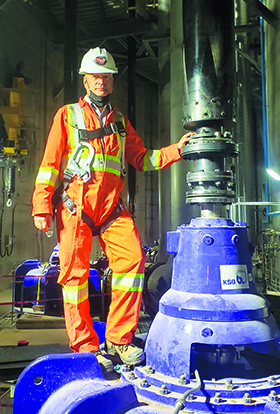 |
| A Rotator Products employee provides engineering consultation at a customer site. |
BIG NEWS
After more than 25 years running a thriving, engineering-forward distribution business, some owners might start winding down into a comfortable coast mode — not Bajaj. He has pivoted to become a partner with one of his overseas manufacturing suppliers that wanted to onshore into the U.S. Now, Bajaj is a partner in a manufacturing company in Columbus, Indiana, which has already grown about 300%, he said.
In addition, Rotator Products is moving into greater digitization of the business, including an AI-business CRM that removes barriers to adoption for sellers. The distributor is also embracing technology that is data-driven and offers more visibility companywide.
All things considered, Bajaj is more than a little positive about his business outlook for 2027. “Absolutely great,” is how he describes it. “We have projects we’ve been working on inhouse that will be executed at the end of 2026 and invoiced in 2027, and it’s going to be a very good year,” he said.
YOU GET AS MUCH AS YOU GIVE
Why every industrial distributor should get involved in their professional association.
Ajay Bajaj has been involved with the Power Transmission Distributor Association (PTDA) since the early 2000s. He has served on the board and became president in 2015. He was also on the team that reignited the Canadian PTDA. Bajaj has served on almost every PTDA committee and currently serves on the PTDA Foundation Board.
In 2025, PTDA presented Bajaj with its highest honor: the Warren Pike Award, which recognizes lifetime achievement in the power transmission/motion control industry. Named for PTDA’s first president and co-founder, the award was coincidentally established in 1984, the same year Bajaj immigrated to Canada.
His commitment to his industry and to PTDA runs deep.
“The beauty about volunteering with your industry association — and it’s amazing — you get as much as you give,” he said. “I’ve had the good fortune of making some connections which have served me well, but all the connections are great, and the industry has very top-notch people. They have helped me tremendously and without seeking any reward or anything in return. That’s the best part of the industry. Once you get involved, it is amazing how much comes back to you.
“Don’t just pay your dues,” he added. “Go attend, and once you get involved, in, say, a committee or something, it is amazing the industry insights that you learn and what’s going on in our industry.
“There’s also a lot of good research associations do, which not everyone takes advantage of. As a small company, we have benefited from being a part of our association — so just imagine what somebody bigger than us can learn.”
This article originally appeared in the September/October 2026 issue of Industrial Supply magazine. Copyright 2026, Direct Business Media.

INDUSTRIAL SUPPLY MAGAZINE



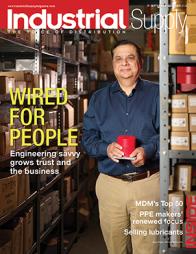
The September/October issue of Industrial Supply magazine features an in-depth cover story about Rotator Products. Plus, we're featuring articles by contributing writers Dr. Bharani Nagarathnam and Frank Hurtte, as well as interviews with numerous product and distribution industry experts.