


The Quote Isn't Won On the Easy Lines
By Cole Weiler
At 10:40 on Tuesday, a customer sends the same 40-line RFQ to three distributors. You're one of them.
 |
| Speed alone doesn't win orders. Price, availability and relationships still matter. But how a team handles those four complicated lines on the RFQ affects whether the quote arrives on time, whether it's right, and whether the team has room for the next complicated request. |
Thirty-six lines are straightforward. Four need work: an unfamiliar customer part number, an unavailable glove, a fitting with no unit of measure and a bolt description missing its grade.
Your rep starts at line one. She enters the easy items, searches the catalog and checks previous orders. By the time she reaches the questions that could hold up the quote, she's spent most of the morning getting ready to ask them.
A competitor works the same request in a different order. AI handles the routine lines, so its rep sees the four problem lines first. She calls the customer about the bolt grade before lunch and starts sourcing the glove while the rest of the quote comes together.
Both distributors have experienced people and supplier relationships. One gets to the decisions sooner, and that's the real advantage.
Speed alone doesn't win orders. Price, availability, and relationships still matter. But how a team handles those four lines affects whether the quote arrives on time, whether it's right, and whether the team has room for the next complicated request.
Find the Questions Earlier
Finishing the easy lines faster helps. Finding the obstacles earlier helps more, because the team can start resolving them while the rest of the quote is still in progress.
Look at your own process. How long does it take a missing spec, a conflicting quantity or an account restriction to reach someone who can resolve it? Can your reps tell at a glance whether a match is likely or confirmed?
The point is to put human attention where judgment is actually required.
Get It Right the First Time
For the fitting, capturing "qty 5" is easy. Knowing whether the customer means five pieces or five boxes takes context. Order history can help, but it should never quietly override what the customer wrote.
A quick answer built on an assumption doesn't stay cheap. It turns into another round of emails, a wrong shipment, a return or a credit, and a buyer who's more cautious about your next quote.
An experienced rep needs the original request, the suggested match and the supporting information side by side. The standard is a quote the team is prepared to stand behind, however fast it goes out.
Quote Work You Used to Pass On
Most teams have requests they quietly skip or answer late: long RFQs, unfamiliar part numbers, products they don't normally stock. Those are often the requests fewer competitors bother to answer.
The unavailable glove is a small version of that problem. Finding an acceptable alternative in a supplier catalog is slow, specialized work.
When routine lines take less of the rep's time, she has more room for sourcing, customer questions and the unusual items that actually need her expertise. That can let the team quote work it used to pass on, without adding headcount.
AI Only Helps If the Rest of the Workflow Keeps Up
Fast extraction alone doesn't close the gap. If the rep still copies information into the ERP, repeats product searches, chases availability and re-enters data across systems, the customer is still waiting.
Distribution Strategy Group's State of Distributor Technology 2026 surveyed 233 North American wholesale distribution executives and found that 55% had invested in ERP, CRM, e-commerce and analytics without integrating them.
Follow an RFQ from arrival to submission. Where does someone retype information? Where does work stop while someone waits for an answer? Where does a second person repeat what the first already did?
AI is worth more when it improves the whole quoting workflow than when it speeds up a single step.
Make the Next Quote Easier
The rep confirms the fitting quantity means boxes and learns which alternative glove the customer will accept. Those decisions are worth keeping.
Recorded with the right context, they let the next person on that account see what happened and why. That matters most for a new hire or someone covering the account for the first time.
A substitution approved once shouldn't become blanket permission, but the team should be able to find the prior decision and understand its limits. Each resolved question should make the next similar request faster to work.
Measure What Actually Changes
There's evidence AI can improve efficiency. In NAW's 2026 AI Adoption Index, as reported by MDM, 47.4% of respondents who had assessed AI's business impact saw a moderate or significant effect on back-office efficiency.
Whether that turns into better quoting is something each distributor has to measure. Track:
- Time from RFQ receipt to a complete quote
- The share of incoming RFQs your team actually quotes
- Corrections, returns and credits tied to quoting errors
- Win rate and gross margin on submitted quotes
Record loss reasons, too. Faster, cleaner quoting won't make up for every price gap or stock shortage. But you should know whether it gets your team into more buying conversations and turns more of them into profitable orders.
Finishing all 40 lines a few minutes faster won't win the Tuesday RFQ. Getting to the four lines that need judgment while a competitor is still working through the other 36 will.
That's where AI changes quoting.
Cole Weiler is co-founder and CEO of BoltWise, where he focuses on applying AI to industrial distribution workflows. He previously spent nearly five years at McKinsey & Company advising manufacturers on supply chain strategy.

INDUSTRIAL SUPPLY MAGAZINE



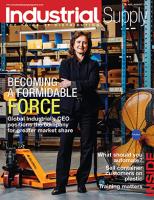

The September/October issue of Industrial Supply magazine features an in-depth cover story about Rotator Products. Plus, we're featuring articles by contributing writers Dr. Bharani Nagarathnam and Frank Hurtte, as well as interviews with numerous product and distribution industry experts.