
 |
by Kim Phelan
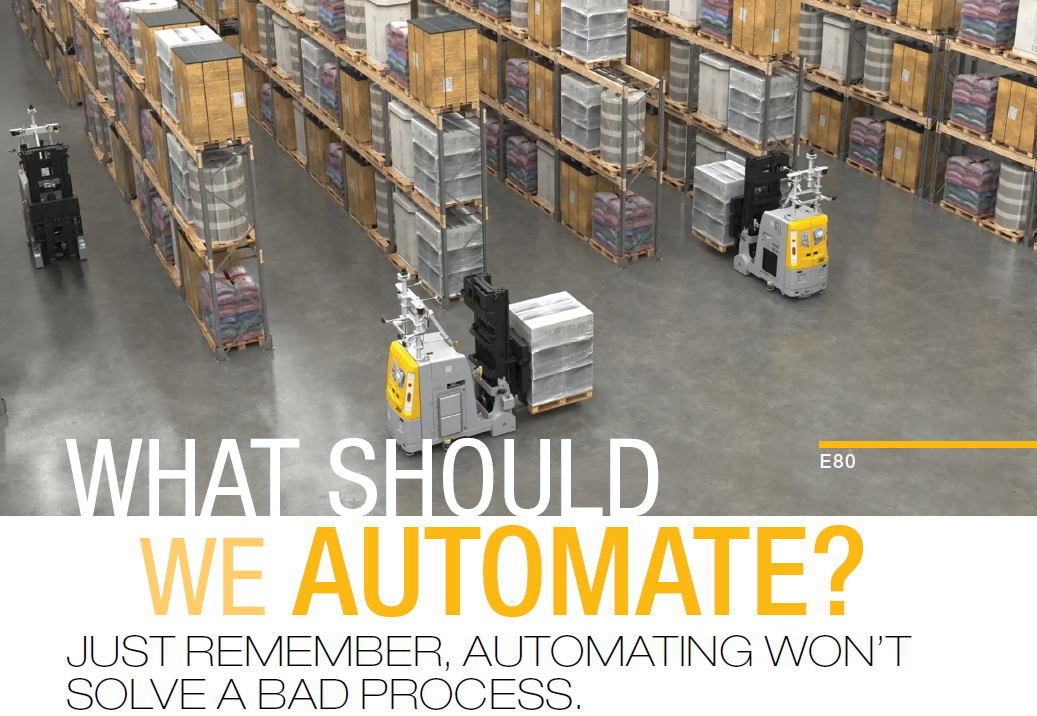
Thinking of investing in warehouse automation or expanding on what’s already been installed? The first thing to do is map your process, even before you evaluate products in the market.
“It’s not necessarily technology that fails during a deployment, but it’s the process that fails,” said Nick Malewicki, general manager, autonomous division at Big Joe Forklifts. “You may have a high SKU mix, so you say you want to automate it because you can’t find labor. But is that inherently a good process to automate?
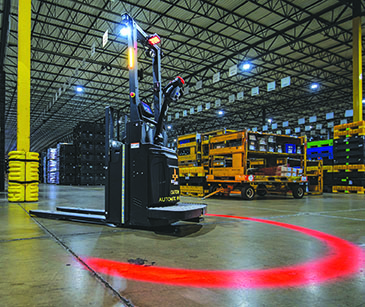 |
| Big Joe Forklifts |
“Understand your processes and understanding what a good automation solution would be for them, don’t automate broken processes,” he added. “Automation is going to only put a spotlight on broken processes … Fix the process first, then automate … Also, don’t let the demo define what your requirements are. You’re not buying the demo.”
Darrin Peuterbaugh, sales director for beverage at E80 Group, agrees you should know the problem—and the strategy—before you add a technology solution. “Before making an investment, distributors should carefully evaluate factors such as current and future throughput requirements, SKU growth and order profile evolution, labor availability and ergonomics, facility constraints, long-term scalability needs, and integration between warehouse, production, and shipping operations.”
Jack Belford, vertical strategy director at Toyota Automated Logistics observed, “There is no longer an adequate, one-size-fits-all approach. For this reason, it is absolutely imperative to look at each fulfillment and warehouse process closely and create a detailed business case before investing in robotics or automation. This applies to both the modernization of existing facilities and the development of greenfield distribution centers designed around the most advanced automation available. In all cases, the comprehensive analysis of underlying processes is key. Automating a less-than-ideal approach simply does the wrong thing faster. The business case should also validate all assumptions in the timeframe being considered – including those for future volume and throughput, ROI projections, labor savings, and more.
ONE NEW THING
Industrial Supply asked its nine supplier sources to identify one new innovation commercially available now. Here’s what was top of mind for these automation company spokespeople, presented in alphabetical order:
Big Joe Forklift. Their fully autonomous, 4,400-pound capacity Pallet Truck AP 44 was launched at the Automate show in June, which builds upon a semi-autonomous AMR the company introduced four years ago. “What’s really cool is that this can operate as a manual end rider, or in semi autonomous mode, or fully autonomous mode, and it was designed specifically to be able to run in those different modes, different zones, all in the same facility simultaneously,” said Malewicki.
He calls it the Swiss army knife of equipment. “You get three different types of equipment in one and, with a software update, move into where it’s a fully autonomous palette truck that can go and pick up the pallet on its own and drop it off with no operator involvement.” An operator can engage a pallet on the built-in touchscreen and send the machine to a destination, or the unit can be programmed ... “it becomes a one-touch decision for them,” he said.
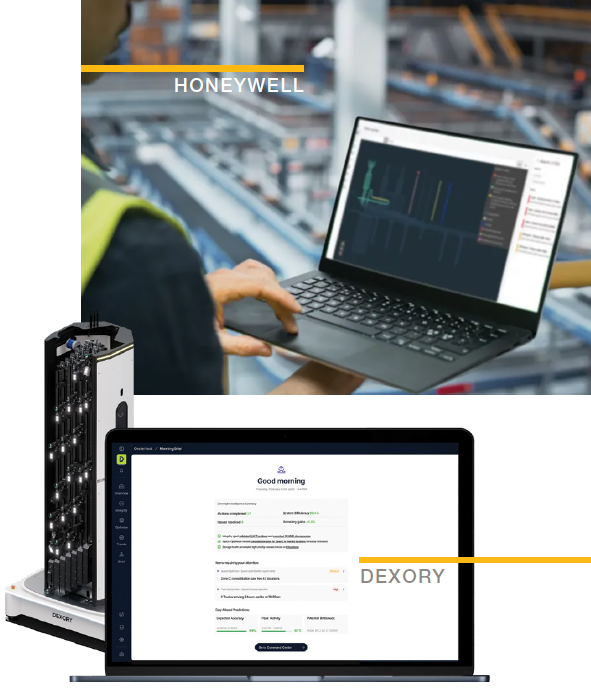 |
Dexory. DexoryView Adapt is a new capability within Dexory’s digital twin platform, designed to help warehouses move from visibility to real-time operational decision-making, says Oana Jinga, co-founder/chief commercial and product officer. “While many warehouse technologies today provide data and visibility, operators still face the challenge of knowing what actions to take and when. DexoryView Adapt addresses this by combining real-time warehouse data, AI-powered reasoning, and digital twin technology to identify operational issues and recommend evidence-backed actions as conditions change.
The platform continuously analyzes data captured by Dexory’s autonomous robots alongside warehouse-specific operational rules and workflows,” Jinga notes. “This creates a live understanding of warehouse activity that can proactively flag issues before they escalate, while also enabling teams to query operations and receive contextual recommendations in real time … A major advantage of DexoryView Adapt is that it enables warehouses to become more adaptive and responsive without requiring significant changes to existing infrastructure or operations.”
E80: A recent innovation is the strategic collaboration between E80 Group and Exotec to design a joint solution that integrates Exotec’s Skypod AS/RS with E80 Group’s pallet-handling systems and end-to-end intralogistics expertise. “What makes the solution valuable is that it reduces fragmentation,” said Peuterbaugh. “Traditionally, we see many facilities have managed item, case, and pallet storage through disconnected systems, creating complex integrations, additional infrastructure costs, and inefficiencies. By combining Exotec’s flexible AS/RS and warehouse execution software with E80 Group’s AGV/LGV systems’ automatic truck unloading/loading solutions and SM.I.LE80 software platform, the collaboration enables a more continuous flow from inbound to outbound logistics.
The highlights include: (1) integrated handling of items, cases and pallets in a single automation ecosystem; (2) scalable storage and order fulfillment for retail and CPG operations; (3) reduced complexity and fewer unnecessary equipment layers; (4) smoother flow from production or inbound logistics to distribution and shipping; and (5) stronger resilience, efficiency and speed across multichannel order fulfillment.
Honeywell. The new IntelliSort Irregulars Sorter helps distributors achieve more reliable and predictable throughput performance through automation, according to Kevin Graebel, chief product officer, Honeywell Intelligrated.
“The solution is built to sort bulky, unstable or irregularly shaped items that would otherwise require significant manual intervention to move. It can handle a wide variety of sizes, weights and package shapes, processing 3,000 to 5,000 irregular parcels per hour,” he said.
The sorter’s modular design enables it to be integrated seamlessly into businesses’ existing sortation infrastructure, helping to improve efficiency, reduce potential downtime and lower maintenance costs. By further automating labor-intensive tasks for parcel and e-commerce operations, the Irregulars Sorter also helps reduce safety risks for personnel.
 |
| KUKA |
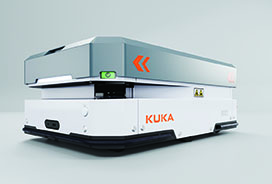
KUKA. The KMP 250P is a compact autonomous mobile robot (AMR) built for intralogistics and smart manufacturing applications, says Brendon Turner, account manager, AMR, KUKA Automation. “Designed to transport loads up to 250 kilograms, the platform integrates seamlessly with KUKA’s broader AMR ecosystem, enabling efficient coordination and management of multiple mobile robots through KUKA AMR Fleet software. Its modular design also allows compatibility with existing chargers and accessories across KUKA’s mobile robot lineup.
“The KMP 250P features advanced safety technology, including 360-degree obstacle detection through laser scanners and 3D cameras, enabling safe autonomous navigation in dynamic environments. KUKA also added an energy-saving sleep mode to improve fleet efficiency. The mobile platform is available in cleanroom and ESD versions for electronics and semiconductor industries.”
 |
| Logisnext |
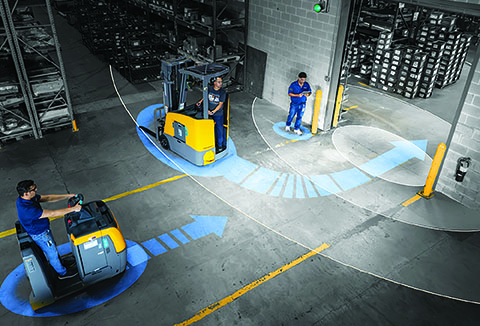
Logisnext. Object Assist and zoneCONTROL from Logisnext are intelligent operator-assist technologies designed to help warehouses achieve their safety goals, by reinforcing safe operating practices, and operational efficiency in manual and mixed-traffic environments, while keeping operators fully in control of their trucks. “For the vast majority of companies that are not willing or able to implement fully autonomous operations at their current stage of warehouse evolution, these solutions provide a practical path to capture meaningful automation benefits today,” said Michael Bloom, director, connected solutions.
Michael Brunnet, senior manager, warehouse and systems truck sales, added, “Instead of requiring a shift to full autonomy, Object Assist and zoneCONTROL focus on targeted risk mitigation, traffic management, and efficiency improvements in environments where human operators remain central to daily operations.”
Object Assist uses a 2D light beam to monitor a forklift’s predicted travel path in real time, taking into account steering angle and vehicle speed. When an object or pedestrian enters that predicted path, the system can alert the operator and automatically slow the vehicle to crawl speed, providing additional time to react and help avoid a potential incident.
zoneCONTROL is an intelligent geofencing solution that uses precise UWB technology to create defined zones within a facility where forklift behavior — such as speed or access —can be automatically adjusted.
 |
| Swisslog |
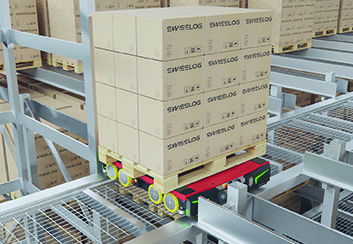
Swisslog. AgileStore is Swisslog’s next-generation roaming pallet shuttle system designed to maximize space, flexibility, and throughput in high-density pallet warehouses. With true four-way shuttle movement, AgileStore supports deep lane storage, intelligent dynamic routing, and efficient use of cubic space. The modular, scalable system is engineered for reliable operation in ambient, chilled, and cold storage environments.
“Unlike conventional systems, AgileStore shuttles move independently across aisles and vertical levels via integrated lifts,” said Nathan York, sales director at Swisslog Logistics Automation. “One robot can make it to any level across a rack-based system to deliver a pallet. The AgileStore provides total access such that every shuttle can reach any load, enabling unmatched flexibility and dynamic routing based on real-time warehouse needs.”
 |
| Toyota Automated Logistics |
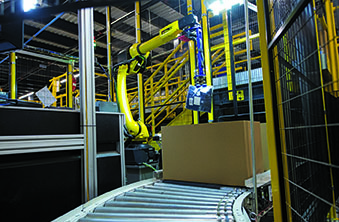
Toyota Automated Logistics. SmartPick is a piece-picking robotic solution that delivers automated, continual throughput with out-of-the-box functionality, all while delivering maximum flexibility and the ability to accurately and quickly pick a wide array of items of different shapes and sizes. “Industrial distributors are leveraging SmartPick to rapidly and repeatedly pick parts and components out of an ASRS and placing the product into the necessary tote, box, or tray,” said Belford. “This rapidly fulfills orders, avoids downtime, drastically improves pick efficiency and reduces overall labor required for picking small components.
“Integrating seamlessly with TAL’s industry-leading Warehouse Execution System (WES), SmartPick features AI-powered vision that maximizes its ability to visualize, identify, pick, and place items from cartons, totes, and trays, while its robotic arm moves along six axis and utilizes independently controlled end effectors and vacuum cups for maximum performance.”
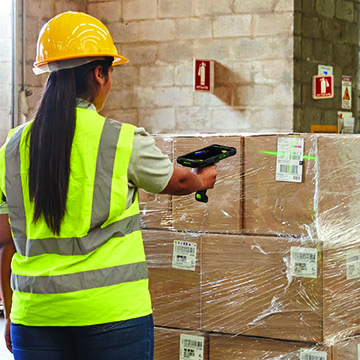
Zebra. “RFID is finally making its way into the warehouse — the overnight sensation 20 years in the making,” quipped Andre Luecht, global strategy, transport, logistics, and warehouse. “Distributors might yawn, but the building of AI into actual workflows, that is something that is truly novel.”
 |
| Zebra |
Zebra’s image-based verification technology puts rules on a device to reinforce that the worker did a task correctly. “If you walk around warehouses and distribution centers, there is so much tribal knowledge … but the actual standard operating procedure is sitting in the site manager’s office collecting dust. What if you put all that on a device, plus the knowledge of the supervisor. That would be extremely helpful.” The AI-enabled technology is built into Zebra’s cameras and can be harnessed through a tablet or other handheld device.
“We can [figuratively] turn every single worker in your distribution center into a supervisor with 20 years of experience,” he said.
Editor’s Note: There’s a lot more to this story than we could fit in print. Starting in July, watch for more insights coming in the Industrial Supply Weekly newsletter.
This article originally appeared in the July/August 2026 issue of Industrial Supply magazine. Copyright 2026, Direct Business Media.

INDUSTRIAL SUPPLY MAGAZINE
The September/October issue of Industrial Supply magazine features an in-depth cover story about Rotator Products. Plus, we're featuring articles by contributing writers Dr. Bharani Nagarathnam and Frank Hurtte, as well as interviews with numerous product and distribution industry experts.