

 |
| istockphoto.com |
by Kim Phelan
Two predominant shifts are occurring in the industrial containers/packaging market: Industrial customers are converting from corrugated cardboard to plastic, and as they grow, customers are converting from manual processes to automated, according to Ben Krempasky, catalog account manager at ORBIS Corp.
The move from paper-based to plastic has several advantages. OEMS and other manufacturing plants and industrial environments use heavy-duty plastic containers to transport components between various tier vendors in the supply chain and also incorporate them into their own factory operations. A key benefit of plastic totes is that some are designed to be collapsible, thus conserving space when not in use.
That’s just the beginning. Plastic containers are durable, easy to use, and recyclable, helping the distributor’s customer achieve their corporate sustainability goals as well as those of their customers.
 |
| Krempasky |
“Large customers can go through a ton of corrugated paper boxes, and they’re starting to figure out that there are rewards if you achieve different environmental standards within your facility,” said Krempasky. “From a recyclability standpoint, these companies … don’t always know if the [cardboard] ends up within a recycling facility and they’re truly being recycled. With ORBIS’s recycling program, we walk them through the process of how we get those products from their facility to our recycling facilities.”
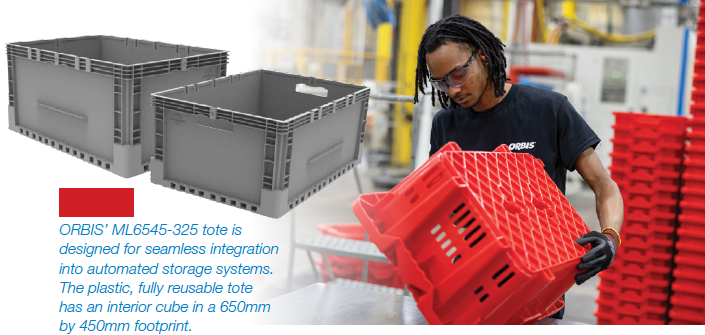
Meanwhile, plastic containers are ready to scale as a manufacturer customer grows — growth in volume comes with automation that is replacing many manual processes and freeing humans to do more intelligent work. Industrial plastic totes withstand being handled by robots (for example, having a graspable lip unlike carboard boxes) and moved along conveyors, complementing expensive automation systems rather than creating a fingers-crossed moment as companies scale, according to Krempasky. Plastic also eliminates concerns about the toll humidity takes on cardboard, including box deterioration and even mold — a consideration distributors can certainly talk through with customers as they weigh their specifications and environments.
HAVING THE DISTRIBUTOR’S BACK
Although distributors have to be knowledgeable in all product categories, it’s tough to be an expert in every SKU. Krempasky emphasizes supplier support for the distributor’s customer should distinguish container makers. “Not only do we make sure that we provide the best quality plastic packaging, but we also make sure we help on the frontline, in the middle of the project, and also on the back end,” he said.
When the customer comes to the distributor ready to embark on the waste-reduction path that plastic packaging enables, he says ORBIS both illuminates and walks the journey with them.
 |
“That’s where I come in,” he said. “I offer my time, jump on a Teams call, or walk the facilities with the distributor’s customer. We show them, here’s where we start. Let’s start taking bites off of this one at a time. What’s the biggest product line that we need to accomplish first? We identify what the footprints are and what the weight capacities and dimensions are. We look at what they’re currently doing, because the biggest thing is to mimic what they’re currently doing so we’re not disrupting their operations.”
He notes that when a supplier provides samples of container product, this gives distributors’ customers a sense of calm about what they’re getting, and so does transparency about scheduling their order. Suppliers should also make the distributor feel supported at every stage of the purchase. That includes after the order. “There might be questions that come about after they make the purchase, and that’s where our backend support comes in,” said Krempasky. “Not only are you buying a product from ORBIS, but you’re also buying the team as well. You’re buying all the support that we have to offer, not just the sales side, the quality side, and product management side. We’re there for the full process, and we have big teams behind us to help through the entire process as well.
“When that distributor or national account manager can immediately go, ‘Hey, I know I can reach out to Ben at ORBIS, and he can help me with these six to 10 different projects for plastic packaging,’ it gives them a calmness, too,” he said. “It assures them they have a support system that they’ll be able to accomplish all these different projects with an expert involved to support them on the back end.”
Krempasky said it’s important to support the distributor by being available in this way. “It may be providing a spec sheet or high-resolution images, or if we need to take the next step, I’ll go on site with the customer and the distributor manager and bring samples with me so they can actually put their hands on it,” he said. “There’s nothing like being able to put your hands on something and actually feel it, test it, and run them through your automated system. That really does reassure the end user that they’re making the right decision.”
KEEP GETTING BETTER
Where is product design going for industrial plastic containers? The ORBIS mentality orbits around continuous improvement, learning what customers want more of and building upon those features. This includes use of recycled content; adding contoured handles and smooth surfaces for easy handling; incorporating specialized materials to help meet specific requirements (to meet clean room and FDA regulations, for example); and meeting tight tolerances for specialized material handling equipment or automated systems.
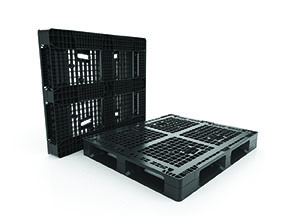 |
| This dimensionally consistent, reusable pallet was designed to provide repeatable performance with automated equipment. The Odyssey Low Profile pallet replaces wood pallets in the supply chain to reduce environmental waste while also providing a durable and reliable solution for product transportation and storage. |
Designing for automation is a clear direction for product development going forward.
“The automation world is getting nothing but bigger by the day,” said Krempasky. “So that’s where ORBIS is concentrating our attention to make sure our products are perfect for the automated systems that they’re being used for, whether it’s an automated fork truck or an automated picking system — whatever it looks like, we are making sure we understand what those systems are, how they pick, how they pack, and how tight the tolerance is. We have to be experts on those systems so there are no issues. We make sure we design pallets that are plug-and-play solutions the customer can immediately start pushing into their system.”
This article originally appeared in the July/August 2026 issue of Industrial Supply magazine. Copyright 2026, Direct Business Media.

INDUSTRIAL SUPPLY MAGAZINE



The September/October issue of Industrial Supply magazine features an in-depth cover story about Rotator Products. Plus, we're featuring articles by contributing writers Dr. Bharani Nagarathnam and Frank Hurtte, as well as interviews with numerous product and distribution industry experts.