


 |
by Mike Hockett
After 2024 marked the first relatively “normal” year for U.S. wholesale distributors since the COVID-19 pandemic in terms of major industry-wide disruption, 2025 business conditions were defined by one word: tariffs.
Distributors knew tariffs were coming with the Trump administration taking office in January of 2025, and that policy kicked into high gear on April 2’s “Liberation Day.” But no one could have predicted the roller coaster of major policy that ensued in the months after.
Shifting tariff proposals, uneven implementation timelines, and uncertainty around product-level exposure created a difficult backdrop for pricing strategy. Distributors were forced to make fast decisions on whether to absorb higher costs, pass them through to customers or hold pricing in place to protect demand — often before they had full visibility into supplier actions or competitive response.
That volatility complicated margin management across the channel. Many distributors found themselves recalibrating price lists, surcharge mechanisms and customer communications more frequently than normal, while sales teams worked to explain cost changes in a market where buyers were already sensitive to inflation. The result was a year in which pricing discipline became both more important and harder to execute.
As 2025 progressed, inflation-driven revenue gains became increasingly visible. Over the final eight months of the year, higher realized prices helped lift topline results across much of wholesale distribution, even as underlying volume growth remained uneven by sector. By year-end, the industry’s revenue scale reflected not only demand resilience but the cumulative impact of tariff-related cost pressure, broader inflation and the pricing actions distributors took to preserve profitability.
 |
This was all against a relatively muted industrial demand backdrop that many publicly traded distributors described as “sluggish” in their quarterly earnings calls throughout 2025 for most durable goods categories.
U.S. wholesale distribution revenue finished 2025 at $8.44 trillion — a new annual high water mark for the industry — up 4.8% compared with 2024. But again, inflation did most of the heavy lifting. Exemplifying distribution’s fragmentation and diversity, certain industry sectors saw excellent 2025 growth led by electrical and electronics riding the data center demand wave, while building materials/construction saw continued decline against a difficult housing market.
The vast majority of the distributors on our lists posted annual sales gains in 2025, and lasting high inflation has the industry set for major revenue growth in 2026. As of mid-June, MDM expects overall U.S. wholesale distribution revenue to increase by high-single digits annually, likely topping the $9 trillion mark this year.
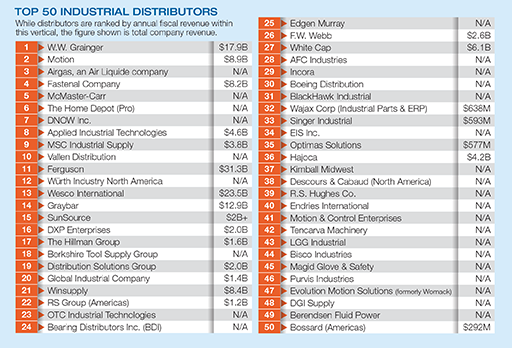
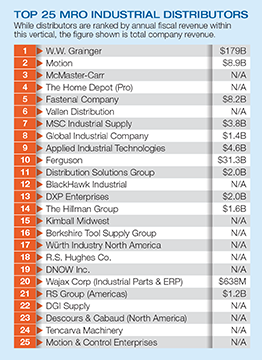
Starting in 2022, MDM put a heightened emphasis on ranking companies by their sector-specific revenues rather than total revenue. This explains why you’ll see some distributors with smaller total revenues ranked higher than others within the same industry. Take Grainger, for example. By its total 2025 revenue of $17.9 billion, Grainger is North America’s largest industrial supplies distributor. But when digging into its financial reports and product sector breakouts, we find that it’s also one of North America’s top distributors of electrical, HVACR, plumbing, power transmission, fluid power and safety products. This is why Grainger appears on 10 of our 20 sector lists — the company’s revenue within each of those segments is large enough to warrant a spot. And this is why Watsco is ranked No. 1 in HVACR and Grainger is No. 5. Despite Watsco’s $7.2 billion revenue being much smaller than Grainger’s, Watsco’s HVACR revenue was much higher than Grainger’s. This explains why you’ll find some companies charted on industry lists outside of their “core” offering.
While our rankings are based on 2025 revenue within each sector, the revenue you see displayed on our lists is overall revenue. Why? Quite simply, while many privatel-yowned distributors elected not to publicly share their total revenues, far fewer elected not to publicly share their sector-specific revenues. If we displayed the sector-specific revenues of those that gave us the OK to, they’d be few and far between. The overall revenue figure gives us something to show for a considerable portion of companies on our lists, though an increasingly larger amount elect to keep theirs private.
 |
That sector-specific revenue breakout is the most painstaking part of our research process, as it involves an incredible amount of hair-splitting and triangulation to find accurate revenues. It makes this feature all the more challenging, but we do it because it results in a more accurate list and levels the playing field.
EDITOR’S NOTE:
Industrial Supply thanks Modern Distribution Management for sharing its 2025 Top 50 Distributors and the Top 25 MRO Distributors lists.
 |
Mike Hockett is executive editor of Modern Distribution Management. He can be reached at mhockett@naw.org.
This article originally appeared in the September/October 2026 issue of Industrial Supply magazine. Copyright 2026, Direct Business Media.

INDUSTRIAL SUPPLY MAGAZINE





The September/October issue of Industrial Supply magazine features an in-depth cover story about Rotator Products. Plus, we're featuring articles by contributing writers Dr. Bharani Nagarathnam and Frank Hurtte, as well as interviews with numerous product and distribution industry experts.