


Wired for Sales
Our future hasn't been invented yet.
by Frank Hurtte
Back when I still had a couple black hairs left, I used to ask distributors a question that made them squirm: “If I came back three years from now, what percentage of your sales would come from products that don’t even exist today?”
We were in the technology business. New products arrived like third graders jumping off the school bus. Every trade show promised something that was going to revolutionize manufacturing. Funny all these revolutions required a booth giveaway and a bowl of peppermints.
Recently, I facilitated a Distributor Advisory Council where the subject of new products surfaced again and again. The conversation stuck with me. For manufacturers, launching new products isn’t a marketing exercise. It’s a financial necessity. Every successful product eventually slows down. Margins shrink. Competitors catch up.
That’s why manufacturers invest millions in research, engineering, testing, certifications, and product launches. Future revenue depends on continually replacing aging products with better ones. Many track this using the New Product Vitality Index—the percentage of revenue generated by products introduced during the past three to five years. It’s one of those wonderfully annoying metrics because it tells the truth whether management wants to hear it or not. When vitality drops, the future usually isn’t far behind.
Distributors should be paying attention, too.
Back in the early 2000s, I conducted an informal survey of automation distributors across North America. I asked what percentage of their sales came from products that hadn’t existed three years earlier. The average answer was one-third. Absorb that for a minute. One out of every three sales dollars came from products that didn’t exist just a few years earlier. Those distributors weren’t growing because they had mastered yesterday’s catalog. They were growing because they knew how to commercialize innovation.
Anybody can sell products customers have been buying for 20 years. The trick is convincing someone to spend money on something they didn’t know existed last Tuesday. Today the challenge is even greater. The average line card looks like somebody emptied four engineering departments into one warehouse. Vision systems, pneumatics, industrial networking, and products that will probably receive three firmware updates before lunch all compete for attention.
If your sales force only knows how to sell products carried for 20 years, congratulations. You qualify as a museum curator. Manufacturers understand something many distributors ignore. Launching a product is only half the battle. The real challenge is customer adoption.
Great distributors shorten the time between product launch and meaningful revenue. They train their people early, educate customers, identify applications, solve startup problems, and create confidence. That’s worth big money. In fact, it’s a competitive advantage that Amazon still can’t put into one of their smiley face boxes. Last time I checked, Amazon wasn’t sending an application engineer to a plant at 6:30 on Tuesday morning.
Unfortunately, too many distributors still sell themselves using yesterday’s language. Things like, we have 18 branches and we’ve been in business since 1954 could also apply to the local funeral parlor. If I’m introducing a breakthrough product, I care far less about your buildings than I do about how quickly you can help customers adopt my technology.
Distributors need to show supply partners their launch process, their technical training and application specialists. Can we demonstrate how quickly new products reach our customers? Can we list how many customers adopted last year’s new products? These are a lot more impressive than flashing a map with 18 locations.
Most importantly, we must show them the numbers. Every distributor should know how much revenue each salesperson generates from products introduced during the past three years. Not because we need another report nobody reads, but because behavior and measurement are linked at the hip.
Here’s the part that ought to keep sales managers awake: Most of tomorrow’s best-selling products haven’t been invented yet. Your competitors don’t know what they are. You don’t know what they are. But some engineer is sketching one on a screen right now, and their company is going to introduce it. Somebody is going to make a lot of money selling it. Shouldn’t it be you?
Being Wired for Sales means tomorrow not just today.

Straight talk, common sense and powerful interactions all describe Frank Hurtte. Frank speaks and consults on the new reality facing distribution. Contact Frank at frank@riverheightsconsulting.com, (563) 514-1104 or at riverheightsconsulting.com.
This article originally appeared in the September/October 2026 issue of Industrial Supply magazine. Copyright 2026, Direct Business Media.

INDUSTRIAL SUPPLY MAGAZINE



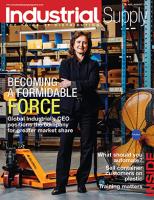

The September/October issue of Industrial Supply magazine features an in-depth cover story about Rotator Products. Plus, we're featuring articles by contributing writers Dr. Bharani Nagarathnam and Frank Hurtte, as well as interviews with numerous product and distribution industry experts.