


Gas density monitoring from Trafag
Trafag, a global supplier of precise measurement and reliable monitoring of pressure, temperature and gas density, says it is setting a new benchmark in gas density monitoring with the introduction of its 87x9 platform.
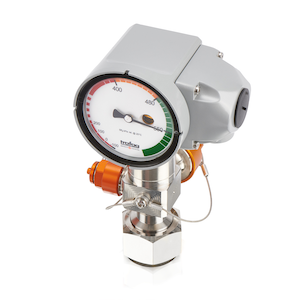 Designed for SF₆ and emerging alternative insulation gas mixtures, the platform combines proven mechanical switching with optional continuous density measurement in one scalable solution for modern gas-insulated equipment. The 87x9 platform will be featured at CIGRE 2026, August 23–28, Booth A38, in Paris, France.
Gas-insulated equipment is facing increasing technical and regulatory demands. New insulation gas concepts, stricter requirements for leakage reduction and documentation, and the growing shift toward condition-based maintenance are raising expectations for gas density monitoring systems.
The Trafag 87x9 platform addresses these requirements with a unified architecture for reliable safety monitoring and future-ready data integration. At its core, the platform uses Trafag’s proven density-based measuring principle with a sealed reference chamber. This enables mechanical temperature compensation and ensures that switching behavior reflects the actual dielectric condition of the gas compartment, rather than short-term pressure effects or local temperature fluctuations.
The platform includes the 8719 mechanical gas density monitor and hybrid variants that add an independent continuous measurement path. Mechanical switching remains available for defined safety-related thresholds, while continuous density measurement provides analog or digital data for trend monitoring, leak detection, documentation, remote supervision and maintenance planning.
“With the 87x9 platform, Trafag gives OEMs and operators a reliable path from proven mechanical gas density monitoring to future-ready digital supervision. It combines safety-critical switching with the data transparency required for alternative insulation gases, leakage reduction and condition-based maintenance,” says Maura Crobu, Product Manager Gas Density Sensing Solutions at Trafag.
Key performance features of the 87x9 platform:
- Switching points — Up to five for mechanical monitors; up to four for hybrid variants
- Switching accuracy — ±10 kPa at 20 °C
- Switching span — Up to 250 kPa
- Measurement principle — Monitor: Density-based system with sealed reference chamber; Sensor: Density-based system with quartz oscillator
- Gas compatibility — Calibrated for defined SF₆ or alternative gas mixtures
- Hybrid measurement — Independent continuous density measurement path
- Output options — Analog or digital density signals, depending on variant
- Service functions — Optional testing, gas sampling, evacuation and filling
- Integration — Flexible gas connections, adjustable electrical interfaces and separate connector housing
Scalable architecture for safety, service and digitalization
The 87x9 platform is not a universal one-size-fits-all device. Each variant is selected and calibrated for the defined gas type, mixture ratio, nominal density and operating pressure range. This makes the platform suitable for established SF₆ applications as well as alternative insulation gas concepts, while maintaining consistent performance and long-term stability.
Its dual-path concept is particularly valuable for operators moving toward digitalized asset management. Mechanical switching provides deterministic protection independent of digital infrastructure. The continuous measurement path, available in hybrid variants, adds the density data required to detect slow leaks, analyze long-term trends, support regulatory documentation and enable condition-based maintenance strategies.
Trafag has also designed the 87x9 platform with lifecycle efficiency in mind. Depending on the application, modular service functions for testing, gas sampling, evacuation and filling can be integrated directly into the device. Routine verification can therefore be performed without disassembling or removing the monitor from the gas compartment. This reduces sealing points, minimizes gas handling and helps lower leakage risk during service interventions.
Flexible gas connections, adjustable electrical interfaces and a separate connector housing simplify integration into different gas-insulated equipment designs and production workflows. This helps OEMs implement consistent monitoring concepts across different applications while reducing installation effort.

INDUSTRIAL SUPPLY MAGAZINE





The September/October issue of Industrial Supply magazine features an in-depth cover story about Rotator Products. Plus, we're featuring articles by contributing writers Dr. Bharani Nagarathnam and Frank Hurtte, as well as interviews with numerous product and distribution industry experts.